
Last fact-check:
AI visibility only becomes commercially meaningful when you can connect it to real user behavior.
An iGaming brand may appear frequently in ChatGPT, Gemini, Perplexity or Google AI features without receiving much measurable traffic. Another site may receive fewer mentions but more high-intent referral visits. A third may attract AI referrals that later register, deposit, generate affiliate revenue or become qualified B2B leads.
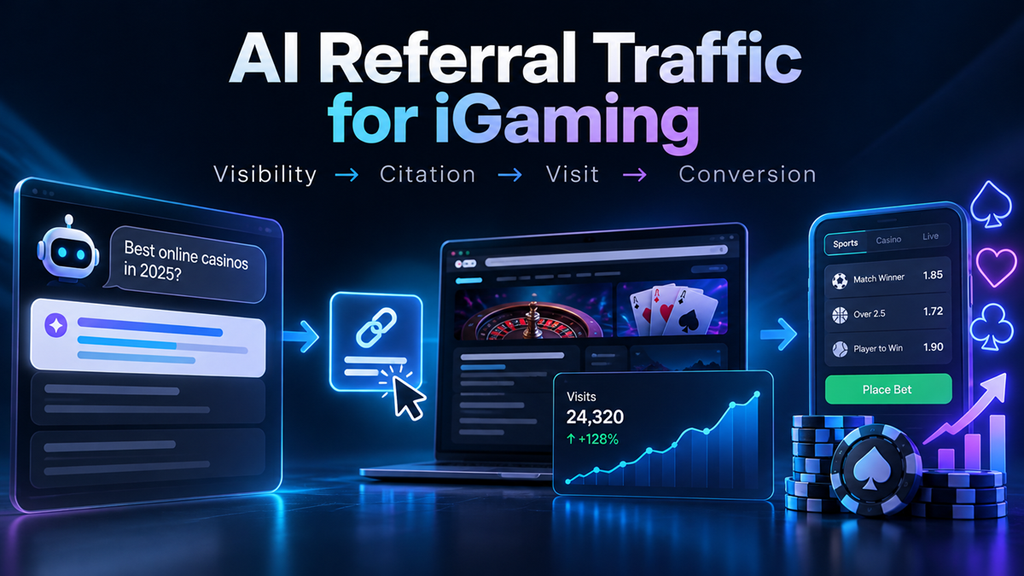
This guide explains how to track that final part of the funnel:
AI Visibility → Citation → Referral Visit → Conversion
For the earlier stages, use our AI Visibility Tracking for iGaming and AI Citation Tracking for iGaming guides.
What Is AI Referral Traffic?
AI referral traffic is website traffic generated when a user clicks from an AI-powered answer, search experience or assistant to your site.
Examples can include a visitor clicking a source link in ChatGPT Search, opening a cited page from Perplexity, following a link surfaced by Gemini, or reaching your website from a Google generative AI result.
The important distinction is that AI visibility is not the same thing as AI traffic. A brand can be visible without receiving a click, and a page can be cited without generating meaningful sessions.
The Measurement Chain
| Stage | Question | Typical data source |
|---|---|---|
| Prompt | Which AI question was tested? | AI visibility tool |
| Mention | Was the brand named? | AI visibility tool |
| Citation | Was your domain or page used as a source? | AI citation tracker |
| Referral visit | Did the user click through? | GA4 / analytics |
| Engagement | What did the visitor do? | GA4 / product analytics |
| Conversion | Did the visit create value? | GA4 + CRM / affiliate / operator data |
No single tool currently gives you this entire chain perfectly. In practice, you usually need to combine AI monitoring with web analytics and business-side conversion data.
1. Track ChatGPT Referral Traffic
OpenAI provides the clearest public referral guidance among the major AI platforms.
OpenAI says ChatGPT automatically adds the parameter utm_source=chatgpt.com to referral URLs from ChatGPT Search, allowing publishers to identify that traffic in analytics tools such as Google Analytics. For ChatGPT-specific discovery and citation strategy, see our ChatGPT Visibility for iGaming guide.
OpenAI publisher and developer FAQ
In GA4, the practical places to look include:
- Reports → Acquisition → Traffic acquisition;
- Session source;
- Session source / medium;
- Landing page combined with the source;
- key events and revenue where configured.
Google defines source as the platform, website or app that referred the visitor, while medium describes the type of traffic such as referral, organic, email or paid traffic.
Google Analytics traffic-source dimensions
2. Track Other AI Referral Sources in GA4
Not every AI platform uses the same standardized tagging system as ChatGPT.
For Gemini, Perplexity and other AI services, inspect the actual referral/source values that appear in your analytics rather than assuming a fixed naming convention in advance. See our Gemini Visibility for iGaming guide for the Gemini Apps versus Google AI Search distinction.
A useful starting workflow is:
- open Traffic acquisition in GA4;
- switch the primary dimension to Session source / medium;
- search for AI-related referring domains that actually appear in your property;
- inspect landing pages and engagement for those sessions;
- save recurring sources in an exploration or reporting view.
This is safer than hard-coding assumptions about how every AI assistant will always identify itself, because referral behavior and product implementations can change.
3. Build an AI Traffic Segment or Exploration
Once you have observed the actual source values in your own analytics, create a repeatable AI traffic view.
The simplest approach is a GA4 Exploration filtered to known AI referral sources and the ChatGPT UTM source. Include dimensions such as:
- session source;
- session medium;
- landing page + query string;
- country;
- device category;
- new vs returning user;
- engaged sessions;
- key events;
- revenue where relevant.
This creates a practical AI acquisition report even before GA4 offers a dedicated standard “AI” channel in your property.
4. Watch for AI Traffic Misclassified as Direct
Analytics attribution is never perfect.
Google explains that traffic can appear as (direct) / (none) when referral information is missing. Causes can include missing campaign parameters, redirects that strip parameters, URL shorteners and ad blockers.
Google Analytics: understand direct traffic
That means your measured AI referral traffic should be treated as a lower-bound estimate rather than a perfect count of every user influenced by AI Search.
For iGaming, this matters because users may also:
- see a brand recommendation in an AI answer and later search the brand in Google;
- copy a URL rather than click the citation;
- open the site in another browser or device;
- return later through direct navigation;
- click an affiliate link from a later visit rather than the original AI session.
This is one reason AI visibility, citations and referrals should be reported together rather than treated as interchangeable metrics.
5. Track Landing Pages From AI Referrals
The landing page often tells you more than the raw session count.
For each AI traffic source, identify which pages attract the visits. Typical iGaming landing pages may include:
- casino reviews;
- sportsbook reviews;
- payment-method pages;
- country guides;
- bonus or promotion pages;
- operator help-centre articles;
- licensing or trust pages;
- original research and data pages.
Then compare those pages with your citation data. A page that is frequently cited and also receives referral sessions is a much stronger AI Search asset than a page that merely appears in a visibility dashboard.
6. Measure Engagement, Not Just Sessions
A referral visit is only the first commercial signal.
For iGaming affiliates, useful engagement events can include:
- operator outbound click;
- comparison-table interaction;
- bonus terms expansion;
- scroll or content-depth milestones;
- newsletter signup;
- tool usage where applicable.
For operators, useful events may include:
- registration start;
- registration completion;
- deposit initiation;
- first deposit;
- app-store click;
- support or verification interaction.
For B2B suppliers and agencies, replace those with lead events such as demo requests, contact submissions, booked calls or trial starts.
7. Connect AI Referrals With Conversions
The most important question is not “How many AI sessions did we get?” but “What commercial value did those sessions create?”
For affiliates, a useful funnel is:
AI referral → content landing page → operator click → registration → FTD → affiliate revenue
For operators:
AI referral → landing page → registration → KYC → deposit → player value
For B2B:
AI referral → product page → demo/contact → qualified lead → opportunity → revenue
GA4 can show traffic source and key-event data, but final revenue attribution may still need to be joined with affiliate-platform, CRM, operator or backend data.
8. Use the Right GA4 Attribution Scope
GA4 exposes traffic-source dimensions at different scopes.
First user source tells you where a user originally came from. Session source tells you what originated the current session. Event-level attribution is used when credit is assigned to key events.
For day-to-day AI referral reporting, Session source / medium is usually the most intuitive starting point because it tells you which source originated that specific visit.
For conversion analysis, also inspect key-event attribution paths rather than assuming the AI session must always be the last click before conversion.
Google Analytics traffic-source scopes
9. Compare AI Referral Traffic With Google AI Visibility
Google Search Console now provides a dedicated Generative AI performance report for Google Search, covering AI Overviews and AI Mode.
The report shows generative-AI impressions and can be segmented by pages, country, device and date. Google says the feature rolled out worldwide by August 31, 2026, although individual sites may still lack visible data if they do not have enough generative-AI impressions.
Google Search Console Generative AI performance report
This creates a useful comparison:
- Search Console: how often your pages are surfaced in Google’s generative AI features;
- GA4: whether visitors actually arrive and what they do;
- AI visibility tools: how you compare with competitors across a controlled prompt set.
10. Build an AI Referral Dashboard
A practical dashboard should combine volume, quality and business outcomes.
| Metric | Why it matters |
|---|---|
| AI referral sessions | Measures identifiable click-through traffic |
| Users | Shows unique audience volume |
| Landing pages | Identifies which content attracts AI visitors |
| Engagement rate | Indicates whether visitors interact meaningfully |
| Key events | Tracks registrations, outbound clicks, leads or other goals |
| Conversion rate | Shows traffic quality |
| Revenue / FTDs / lead value | Connects AI acquisition with commercial results |
| AI citations | Explains which pages may be generating source visibility |
| AI share of voice | Adds competitive context |
The strongest reports bring these metrics together instead of presenting referral traffic in isolation.
AI Referral Traffic for iGaming Affiliates
Affiliates should pay particular attention to the gap between AI referral sessions and affiliate conversions.
A citation may send a user to a comparison page, but the commercial outcome occurs only if that visitor then clicks an operator, registers and eventually becomes a qualified player.
Useful affiliate reporting fields include:
- AI source;
- landing page;
- operator outbound click;
- operator brand clicked;
- country;
- registration;
- FTD;
- revenue where available.
See our AI Search Optimization for iGaming Affiliates guide for the broader affiliate strategy.
AI Referral Traffic for Casino Operators
Casino operators should connect AI referrals to registration, KYC, first deposit and player-value data where possible.
That can reveal whether AI visitors behave differently from organic search or affiliate traffic. A small AI channel with a high registration or deposit rate may be more strategically important than its session volume suggests.
See our AI Visibility for Online Casinos guide.
AI Referral Traffic for Sportsbooks
Sportsbooks should distinguish evergreen AI referrals from traffic driven by time-sensitive event or betting questions.
Landing-page analysis is particularly useful here. Traffic to evergreen pages about payments, rules, apps or betting features may behave very differently from traffic to event-specific or promotional pages.
See our AI Search Optimization for Sportsbooks guide.
Which Tools Help With AI Referral Measurement?
The measurement stack usually combines several tools rather than relying on one platform:
- GA4 or another analytics platform for sessions, landing pages and conversions;
- AI visibility software for prompt, mention, citation and share-of-voice tracking;
- Google Search Console for Google’s first-party generative AI visibility data;
- affiliate or operator back-office data for registrations, FTDs and revenue;
- CRM data for B2B lead quality and revenue.
Some AI visibility platforms also include referral analytics or GA4 integrations. For software comparisons, see our Best AI Visibility & GEO Tools for iGaming and Best AI Tools for iGaming Affiliates pages.
Common AI Referral Tracking Mistakes
- Assuming every AI mention creates a click. Many answers satisfy the user without a visit.
- Looking only at session volume. Conversion quality matters more than raw traffic.
- Ignoring landing pages. Page-level analysis reveals what content actually attracts AI visitors.
- Using only first-user attribution. Session-level data is usually more useful for referral reporting.
- Assuming all AI platforms identify themselves consistently. Use observed source/referral data from your own property.
- Ignoring direct traffic leakage. Missing referrer information can undercount AI-originated visits.
- Stopping at GA4. FTDs, player revenue and affiliate commissions often live in separate systems.
A Practical Monthly AI Referral Report
For most iGaming teams, a useful monthly report can include:
- AI referral sessions by source;
- users by source;
- top AI landing pages;
- engagement rate;
- key events;
- conversion rate;
- FTDs, leads or revenue;
- top cited pages;
- AI visibility / share of voice;
- three to five actions for the next month.
The purpose is not to create another large dashboard. It is to understand whether AI Search is producing measurable acquisition value and which pages, sources and markets are responsible.
FAQ
Can Google Analytics track ChatGPT traffic?
Yes. OpenAI says ChatGPT Search automatically includes utm_source=chatgpt.com in referral URLs, which allows publishers to identify inbound ChatGPT traffic in analytics tools such as Google Analytics.
Can GA4 identify traffic from every AI platform?
GA4 can identify traffic when referral or campaign-source information reaches the site. Not every AI platform uses the same tagging system, and some referral information may be missing, so inspect the actual source values in your own property rather than assuming complete coverage.
Why does some AI traffic appear as direct?
Google explains that traffic can be classified as direct when no referral information is available. Redirects, missing campaign parameters, URL shorteners and ad blockers can all contribute to lost source information.
Should AI traffic be measured separately from AI citations?
Yes. A citation measures source visibility. Referral traffic measures actual click-through visits. They should be connected in reporting but treated as different metrics.
What is the most important AI traffic metric for iGaming?
There is no single metric. Session volume, landing pages, engagement, registrations, FTDs, leads and revenue answer different questions. For commercial teams, conversion quality is usually more important than raw AI referral volume.
Final Takeaway
AI referral traffic is the bridge between visibility and business value.
Track identifiable AI sources in GA4, inspect landing pages, measure engagement and key events, connect those visits to FTDs, leads or revenue, and compare the result with your visibility and citation data.
The most useful reporting model is:
Visibility → Citation → Visit → Conversion → Revenue
That sequence gives an iGaming team a much clearer picture of whether AI Search is merely generating impressions — or actually contributing to acquisition.