
Last fact-check:
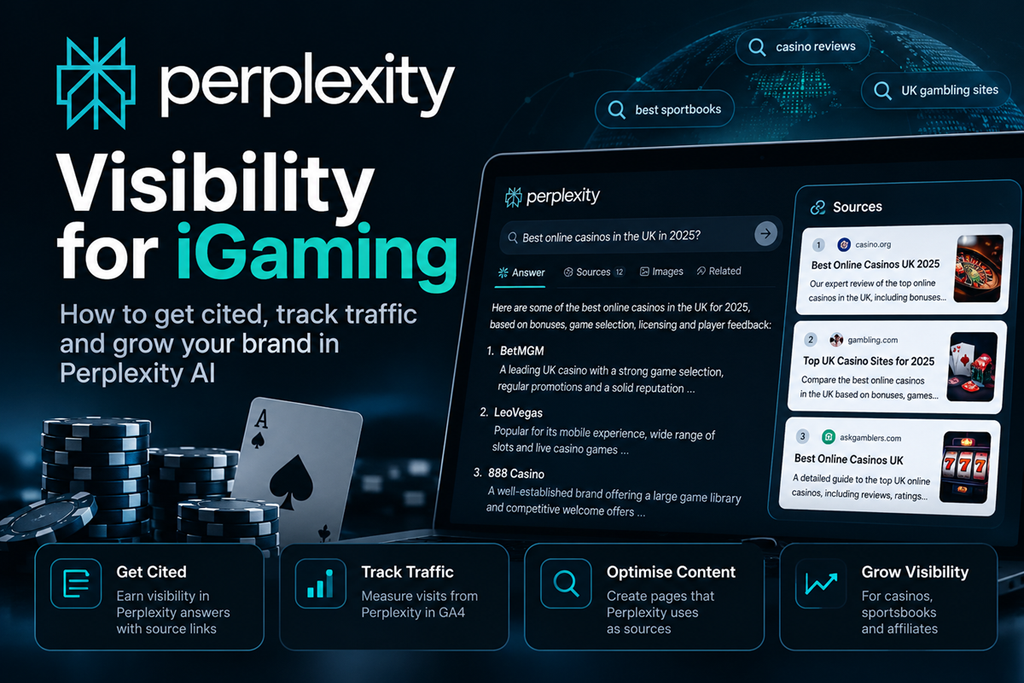
Perplexity is unusually important for AI Search measurement because citations are not an optional extra around the answer — they are a core part of the product. Perplexity describes itself as an AI answer engine that researches the open web in real time and returns cited answers, with source links users can inspect directly.
For iGaming businesses, that creates a clear opportunity and a clear measurement problem. A casino, sportsbook or affiliate can ask:
- Does Perplexity mention our brand?
- Does it cite our website?
- Which affiliate, regulator or media sites are cited instead?
- Which pages earn repeat citations?
- Does visibility differ between countries and languages?
- Do Perplexity citations generate measurable referral traffic?
This guide explains how we approach Perplexity visibility for iGaming, including crawler access, source authority, prompt tracking, citation analysis and referral measurement.
For the broader multi-platform framework, see our AI Search Optimization for iGaming guide.
What Does Perplexity Visibility Mean?
Perplexity visibility has several layers.
| Visibility type | Example | What it means |
|---|---|---|
| Brand mention | Perplexity recommends Sportsbook A | The brand appears in the generated answer |
| First-party citation | Perplexity cites Sportsbook A’s help or product page | The operator site is being used as supporting evidence |
| Third-party citation | Perplexity recommends Sportsbook A but cites Affiliate B | The operator gains brand visibility while Affiliate B gains source visibility |
| Publisher citation | An affiliate review is cited without the affiliate brand being discussed | The publisher still gains source visibility and possible referral traffic |
| Referral visit | A user clicks a citation | Source visibility becomes measurable traffic |
For Perplexity specifically, citations deserve particularly close attention because source links are built into the answer experience.
1. Allow PerplexityBot if You Want Search Visibility
Perplexity’s current documentation says PerplexityBot is its search crawler. It is designed to surface and link websites in Perplexity search results and is not used to crawl content for AI foundation-model training.
Perplexity recommends allowing the crawler in robots.txt if you want the site to appear in its search results.
User-agent: PerplexityBot
Allow: /
Perplexity also publishes current IP ranges for PerplexityBot and recommends permitting those requests when a firewall or WAF could otherwise block them.
Perplexity crawler documentation
2. PerplexityBot and Perplexity-User Are Different
Perplexity currently documents two different agents relevant to website owners.
| Agent | Purpose | Important distinction |
|---|---|---|
| PerplexityBot | Search crawling and indexing | Designed to surface and link websites in search results |
| Perplexity-User | User-triggered page visits | Used when a user request causes Perplexity to fetch a page |
Perplexity says Perplexity-User is not a general web crawler and is not used to collect content for training foundation models. Because the fetch is initiated by a user request, Perplexity says it generally ignores robots.txt rules.
This distinction matters when diagnosing logs. A Perplexity-User visit does not necessarily mean the page has been indexed by PerplexityBot, and blocking PerplexityBot is a separate choice from how user-triggered requests behave.
3. Check the WAF, CDN and Firewall as Well as robots.txt
Perplexity explicitly warns that a Web Application Firewall can prevent its agents from accessing content even when robots.txt allows them.
For Cloudflare and AWS WAF, Perplexity recommends combining the expected User-Agent with its published IP ranges rather than relying on User-Agent matching alone.
For iGaming websites, common access problems can include:
- Cloudflare bot protection;
- country-level blocking;
- IP reputation rules;
- security plugins returning 403 responses;
- JavaScript-only content;
- login or age-gate implementations hiding public information;
- incorrect canonical or noindex directives.
Perplexity says crawler-control changes can take up to roughly 24 hours to be reflected by its systems.
4. Perplexity Is Fundamentally Citation-Led
Perplexity describes its core Search experience as returning cited answers from the web. Its current user documentation says facts and figures are backed by clickable citations so users can verify the original source.
Perplexity getting-started guide
That makes citation analysis particularly actionable. Instead of asking only “Does Perplexity recommend us?”, inspect:
- which domains appear in the source set;
- which exact URLs are cited;
- which source type wins by prompt;
- whether your page is cited repeatedly;
- which competing sources gain or lose visibility over time.
Our AI Citation Tracking for iGaming guide explains how to turn this into a repeatable source-share report.
5. Build Pages Perplexity Can Parse and Understand
Perplexity has publicly described a content-understanding system that parses webpages and extracts semantically meaningful information using dynamic rules.
That does not mean publishers should create artificial “Perplexity blocks.” It does reinforce the value of pages where important facts are clear, structured and easy to distinguish from navigation, advertising and decorative content.
For iGaming, useful structures include:
- clear headings;
- accurate comparison tables;
- visible payment and withdrawal details;
- country-specific availability;
- licensing information;
- original data and testing evidence;
- concise explanations alongside deeper supporting detail.
Perplexity: Architecting and Evaluating an AI-First Search API
6. Keep High-Volatility iGaming Facts Fresh
Perplexity places strong emphasis on current web search. That makes freshness particularly relevant for iGaming facts that change frequently.
Examples include:
- sportsbook promotions;
- country restrictions;
- payment methods;
- licensing status;
- bonus terms;
- event and betting information;
- withdrawal limits and processing policies.
Perplexity has also described using machine learning to decide which URLs should be indexed and when to refresh them, including consideration of likely update frequency.
For publishers, the practical lesson is simple: genuinely review volatile facts when they change. Do not rely on automatically changing “updated” dates as a substitute for real maintenance.
7. Strengthen Entity Consistency
A Perplexity answer may combine information from multiple sources. That makes inconsistent brand facts a real risk.
For casinos and sportsbooks, keep the following consistent wherever possible:
- operator name and official domain;
- ownership or legal entity;
- licence and regulator;
- countries accepted or restricted;
- currencies and payments;
- app availability;
- support channels;
- product features.
For affiliates, entity clarity also means making the publisher identity, methodology, authorship, review process and update policy easy to understand.
8. Treat Third-Party Sources as Part of Your Perplexity Footprint
Perplexity may cite the operator, an affiliate, a regulator, a media article or another source depending on the question.
If a competitor is consistently recommended, inspect which sources support those recommendations. You may find that the important gap is not on your own website at all.
Possible actions include:
- correct outdated affiliate reviews;
- improve regulator-aligned licensing information;
- publish original industry or product data;
- earn legitimate media coverage;
- improve first-party pages where competitors currently provide better evidence.
Do not assume that buying generic PR placements automatically creates Perplexity citations. Source selection is query-dependent and no credible provider can guarantee that a particular URL will be cited for a particular prompt.
9. Track Perplexity by Country, Language and Intent
iGaming recommendations depend heavily on location.
A sportsbook available in Nigeria may not be appropriate for the UK. A casino supporting Arabic may not accept every Gulf market. Payment methods, currencies, regulations and bonus terms can differ significantly.
Build prompt groups around:
- country;
- language;
- operator or affiliate brand;
- casino vs sportsbook intent;
- payment method;
- trust/licensing questions;
- comparison and discovery questions.
A single global “Perplexity visibility score” can hide major local differences.
10. Build a Repeatable Perplexity Prompt Set
| Prompt group | Example | What to inspect |
|---|---|---|
| Brand trust | Is Casino X safe and licensed? | Brand description + regulator/review sources |
| Casino discovery | Best online casinos in Finland | Recommended brands + cited affiliates/operators |
| Sportsbook discovery | Best football sportsbooks in Nigeria | Operators + product/source coverage |
| Payments | Which casinos support PayPal withdrawals? | First-party payment pages + affiliates |
| Comparison | Casino X vs Casino Y | Which sources determine the comparison |
| Publisher discovery | Which websites have reliable casino reviews? | Affiliate brand visibility |
Run the same core prompts repeatedly. Perplexity answers and source sets can change, so isolated screenshots should be treated as observations rather than permanent rankings.
11. Measure Citations, Not Just Mentions
For every tracked Perplexity prompt, record at least:
- whether your brand was mentioned;
- whether your domain was cited;
- the exact cited URL;
- which competitors were mentioned;
- which competing domains were cited;
- the source type: operator, affiliate, regulator, media, forum or other;
- country/language context;
- date observed.
This lets you measure citation share over time instead of treating every source link as an isolated win.
12. Use AI Visibility Tools for Repeat Monitoring
Manual Perplexity searches are useful for inspecting answers and citations. Dedicated monitoring platforms make repeated testing easier.
Depending on the product and plan, tools may track Perplexity alongside ChatGPT, Gemini, Google AI and other platforms.
Useful metrics include:
- mention frequency;
- citation frequency;
- share of voice;
- cited domains and URLs;
- competitor visibility;
- market and language differences;
- changes over time.
See our Best AI Visibility & GEO Tools for iGaming comparison and Best AI Tools for iGaming Affiliates.
13. Track Referral Traffic Separately
A Perplexity citation is not the same thing as a referral visit.
In analytics, inspect actual referring/source values that arrive from Perplexity rather than assuming every citation generates a click or that every visit will always use the same standardized campaign tag.
Track:
- AI referral sessions;
- landing pages;
- engagement;
- operator outbound clicks for affiliates;
- registrations and FTDs;
- leads for B2B sites;
- revenue where available.
Our AI Referral Traffic for iGaming guide explains the GA4 measurement framework.
Perplexity Visibility for Casino Operators
Casino operators should monitor how Perplexity describes licensing, market availability, payment methods, withdrawals, bonuses, game categories and ownership.
Pay special attention to third-party citations. A casino may be described using affiliate or regulatory sources even when its own site contains the same information.
See our AI Visibility for Online Casinos guide.
Perplexity Visibility for Sportsbooks
Sportsbooks have the additional challenge of rapidly changing events, odds and promotions. Separate stable questions about the operator from volatile event-specific questions.
Track country, sport, league, payment and product-feature prompts independently, and inspect whether sources are current enough for the claims being made.
See our AI Search Optimization for Sportsbooks guide.
Perplexity Visibility for iGaming Affiliates
Perplexity’s citation-led interface makes it particularly interesting for affiliates.
An affiliate does not need to be the recommended casino or sportsbook. If a review, payment guide, country page or comparison article becomes a repeated source, the publisher gains citation visibility and potential referral traffic.
For affiliates, prioritize content that contains evidence difficult to reproduce elsewhere: first-hand testing, local payment verification, withdrawal tests, screenshots, original comparisons, transparent methodology and genuinely current operator facts.
See our AI Search Optimization for iGaming Affiliates guide.
A 90-Day Perplexity Visibility Plan
| Period | Priority | Actions |
|---|---|---|
| Days 1–30 | Access and baseline | Check PerplexityBot, WAF access, build prompt set, record current mentions/citations and identify cited competitors |
| Days 31–60 | Content and facts | Improve cited-topic pages, fix entity inconsistencies, strengthen country/payment/product information and refresh volatile facts |
| Days 61–90 | Authority and outcomes | Address citation gaps, improve third-party coverage, measure source share and connect Perplexity referrals with conversions |
Common Perplexity Visibility Mistakes
- Blocking PerplexityBot. This can prevent the site from being surfaced normally in Perplexity search results.
- Ignoring the WAF. robots.txt may allow access while Cloudflare or another firewall blocks it.
- Confusing PerplexityBot with Perplexity-User. They serve different purposes.
- Tracking only brand mentions. Citations are one of Perplexity’s most valuable visibility signals.
- Ignoring exact cited pages. Domain-level citation counts can hide the real content opportunity.
- Ignoring geography and language. iGaming source sets can change significantly by market.
- Using stale operator facts. Perplexity emphasizes current web search, so outdated information is especially risky.
- Assuming citations equal traffic. Measure clicks and conversions separately.
FAQ
How can an iGaming website appear in Perplexity?
Perplexity recommends allowing PerplexityBot in robots.txt and permitting requests from its published IP ranges. Make sure CDN and WAF rules do not block the crawler. Eligibility does not guarantee that a particular page will be cited for a particular prompt.
Does Perplexity respect robots.txt?
Perplexity says PerplexityBot respects robots.txt rules. Perplexity-User is different: it handles user-requested page fetches and generally ignores robots.txt because the user initiated the request.
Does Perplexity use website content for foundation-model training?
Perplexity’s current crawler documentation says PerplexityBot is not used to crawl content for AI foundation models, and Perplexity-User is also not used to collect content for foundation-model training.
Why are citations especially important in Perplexity?
Perplexity is built around cited answers. Its current product information says answers are grounded in web sources and include clickable citations, which makes page-level source tracking particularly useful for publishers.
Can an affiliate gain visibility without being named?
Yes. An affiliate page can be cited as a source while Perplexity recommends an operator. That is why citation visibility and brand visibility should be measured separately.
Can I track Perplexity referral traffic?
Yes, when referral/source information reaches your analytics platform. Inspect the actual source and referrer values in your own property and connect those visits with landing pages, engagement and conversions.
Final Takeaway
Perplexity is one of the clearest examples of why AI Search optimization should not be reduced to “LLM rankings.”
The useful framework is:
Crawlable → Understandable → Current → Cited → Clicked → Converted
Allow PerplexityBot if you want search eligibility, make sure your WAF does not block it, keep iGaming facts accurate and current, create pages worth citing, monitor exact source URLs and competitor citation patterns, and connect citation visibility to measurable referral traffic and commercial outcomes.