
Last fact-check:
Search visibility in iGaming is no longer limited to where a casino, sportsbook or affiliate website ranks in Google.
Players, marketers and industry decision-makers can now ask ChatGPT, Gemini, Perplexity and other AI systems direct questions such as:
- What are the safest online casinos?
- Which sportsbooks have the fastest withdrawals?
- Which casino accepts a particular payment method?
- What are the leading iGaming affiliate platforms?
- Which betting software provider should an operator consider?
- What are the best crypto casinos for a specific market?
The answer may contain only a handful of brands. It may cite third-party websites rather than the brands themselves. And the user may never open a conventional search-results page.
AI Search Optimization for iGaming is the process of improving how a gambling-related brand, company or website is understood, mentioned, cited and recommended within these AI-powered discovery experiences.
You may also encounter terms such as Generative Engine Optimization (GEO), Answer Engine Optimization (AEO), AI SEO and LLM SEO. They overlap substantially, and throughout this guide we use AI Search Optimization as the broader term covering all of them.
For iGaming businesses, the goal is not to find a secret trick that “ranks a casino #1 in ChatGPT.” No such stable ranking system exists.
The more useful objective is to improve the quality and consistency of the signals that AI systems can discover about your brand – and then measure whether your visibility changes.
What Is AI Search Optimization for iGaming?
AI Search Optimization is the process of making information about an iGaming brand easier for AI-powered search and answer systems to:
discover, understand, verify, retrieve, cite and recommend.
It combines elements of:
- technical SEO;
- content strategy;
- entity optimization;
- digital PR;
- structured information;
- reputation management;
- citation analysis;
- conventional search visibility;
- AI visibility monitoring.
For example, imagine a player asks:
“Which online casinos offer fast withdrawals and support EUR?”
An AI system may gather information from operator websites, review sites, industry publications and other accessible sources before generating its response.
The operator therefore has more than one visibility problem.
Its own website needs to contain accurate, accessible information.
Third-party sources should describe the brand accurately.
Its payment and withdrawal information should be consistent.
Its country availability should not be ambiguous.
Its reputation across external sources matters.
And the company needs some way of measuring whether it appears in these answers in the first place.
That is the wider scope of AI Search Optimization.
GEO vs AEO vs AI SEO vs LLM SEO
The terminology is still developing, and different companies use the same terms differently.
For practical purposes, we use the following framework:
| Term | Meaning | Primary focus |
|---|---|---|
| SEO | Search Engine Optimization | Traditional search rankings, traffic and discoverability |
| AEO | Answer Engine Optimization | Making information easy to extract for direct answers |
| GEO | Generative Engine Optimization | Visibility, mentions and citations within generative AI answers |
| LLM SEO | Large Language Model SEO | Visibility within systems powered by large language models |
| AI SEO | AI-focused Search Engine Optimization | Broad commercial term encompassing AI-search visibility |
| AI Search Optimization | Umbrella term we prefer | Visibility across AI-powered search and answer experiences |
These should not be treated as completely separate disciplines.
In practice, the strongest strategies overlap.
A technically poor website will struggle regardless of whether you call the work SEO or GEO. Weak content does not become valuable because it contains AI-friendly headings. And a brand with conflicting information across dozens of websites can create problems for both conventional and AI-powered discovery.
An Important iGaming Terminology Problem
In gambling marketing, GEO already commonly means geographic market.
An affiliate manager may say:
“Our strongest GEO is Canada.”
In AI marketing, GEO means:
Generative Engine Optimization.
For this reason, we usually write Generative Engine Optimization (GEO) when ambiguity is possible.
We recommend that iGaming businesses do the same.
Does Traditional SEO Still Matter?
Absolutely.
AI Search Optimization should not be treated as the replacement for SEO.
Google’s current official guidance states that its established SEO fundamentals remain relevant to AI Overviews and AI Mode. Google also states that websites do not need special AI markup, special schema or an llms.txt file to become eligible for its generative AI search features. Pages must still be crawlable, indexable and eligible to appear in normal Google Search.
That makes sense.
AI-powered discovery still relies heavily on accessible web information.
Strong SEO therefore remains valuable because it contributes to:
- crawlability;
- site architecture;
- authority;
- content quality;
- internal linking;
- entity clarity;
- indexation;
- page performance;
- discoverability of source material.
The mistake is thinking that traditional rankings tell you everything about AI visibility.
They do not.
A casino can have excellent Google rankings while rarely appearing in AI recommendations. Conversely, a third-party page that is not the highest-ranking organic result may still influence an AI-generated answer.
The two channels overlap, but they should be measured separately.
Why AI Search Optimization Is Different for iGaming
Gambling is not a normal ecommerce category.
An AI system attempting to answer a question about an online casino may need to understand far more than a product name and price.
Relevant information can include:
- operating company;
- gambling licence;
- country availability;
- restricted jurisdictions;
- minimum age;
- deposit methods;
- withdrawal methods;
- supported currencies;
- withdrawal limits;
- KYC requirements;
- bonus conditions;
- game providers;
- sportsbook coverage;
- responsible gambling measures;
- customer support;
- regulatory status.
Many of these details can change.
A casino may stop accepting one country while continuing to operate elsewhere.
A payment method can disappear.
A licence can change.
A welcome bonus can be replaced.
An affiliate page can contain outdated information long after the operator has updated its own website.
This creates a distinctive AI-search problem:
The internet may contain several conflicting versions of the same brand.
For iGaming companies, factual consistency is therefore not simply an editorial issue.
It is part of AI visibility.
How AI Search Finds Information
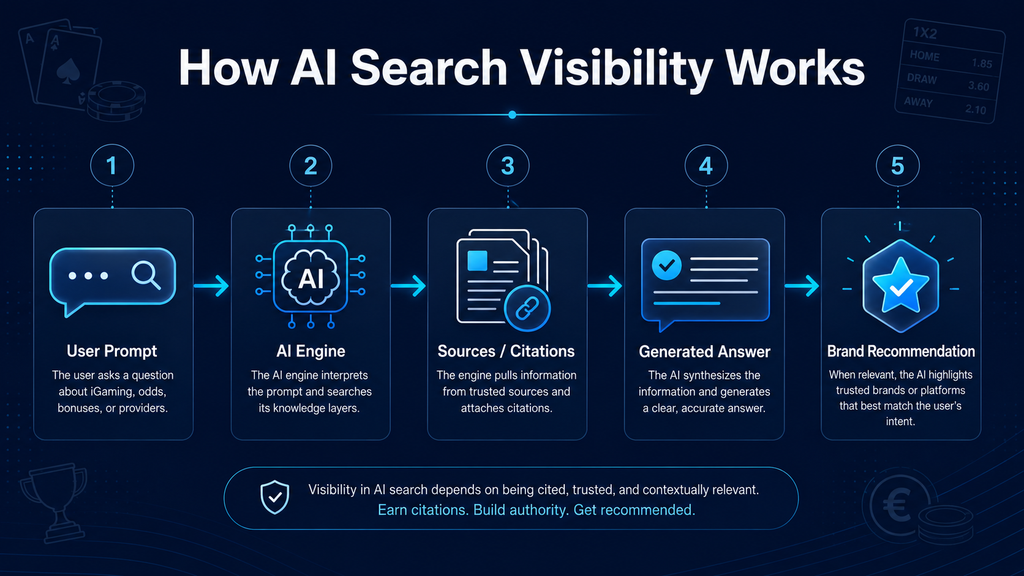
Different AI platforms work differently, and their systems continually change.
However, a simplified process often involves several stages.
Discovery
The system needs to know that a page or source exists.
That means content should not be hidden behind technical barriers that prevent relevant crawlers from accessing it.
For ChatGPT search specifically, OpenAI currently tells publishers that public websites can be eligible to appear and that sites should allow OAI-SearchBot if they want their content discoverable for summaries, citations and links. Our ChatGPT Visibility for iGaming guide covers the platform-specific strategy.
Retrieval
The system identifies information that may help answer the user’s question.
For Google AI Mode and AI Overviews, Google says its systems can use a technique called query fan-out, issuing multiple related searches across subtopics and data sources before constructing an answer.
This has an important implication.
A page does not necessarily need to match one exact keyword phrase to be relevant.
Its broader topical usefulness matters.
Verification
AI systems need enough information to determine whether a claim is credible.
If five trustworthy sources say one thing and a casino landing page says something different, the brand’s own claim may not automatically win.
This is why third-party reputation and factual consistency matter.
Synthesis
The system creates an answer from the information it retrieves.
At this stage, your company may be:
- recommended;
- mentioned;
- compared;
- cited;
- omitted;
- described incorrectly.
AI Search Optimization attempts to improve the inputs that influence those outcomes.
The 8 Foundations of iGaming AI Search Optimization
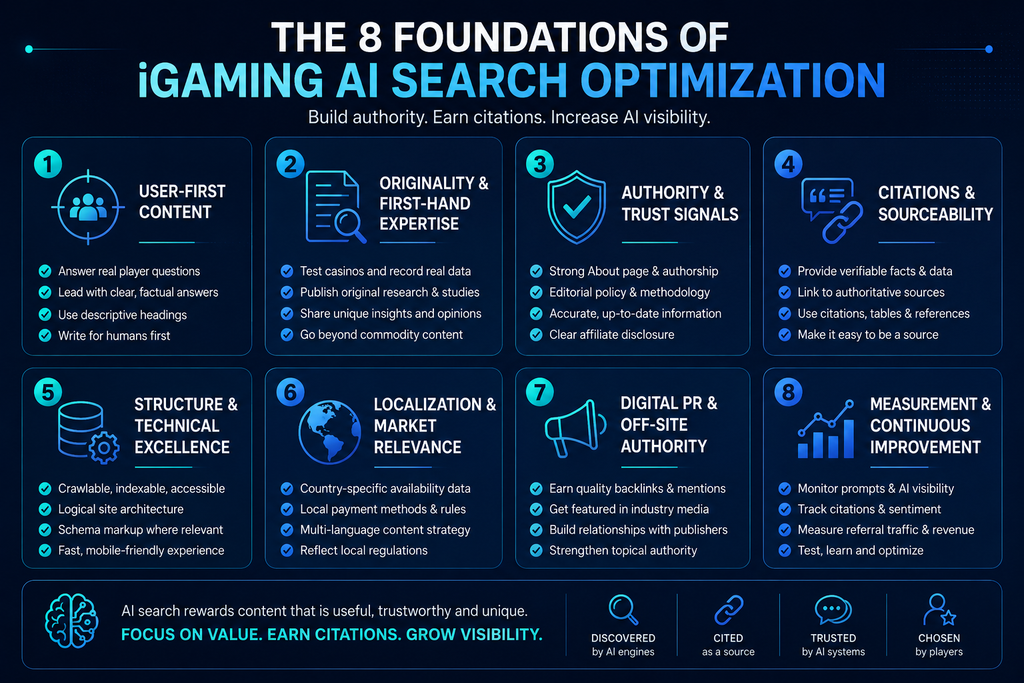
There is no single GEO tactic that solves everything.
We would divide the work into eight areas.
1. Make Important Content Technically Accessible
Start with the basics.
A sophisticated GEO strategy is irrelevant if search systems cannot reliably access the information.
Important content should generally be:
- crawlable;
- indexable where appropriate;
- available as actual text;
- internally linked;
- fast enough to access reliably;
- usable on mobile;
- free from unnecessary technical barriers.
Check:
robots.txt
Make sure important search crawlers are not being blocked accidentally.
CDN and firewall rules
Bot-protection systems can sometimes block legitimate crawlers.
JavaScript
Do not unnecessarily hide essential information behind interfaces that require complicated client-side interaction.
HTTP responses
Important pages should return correct status codes.
Canonical tags
Avoid confusing search systems with multiple conflicting URLs for the same content.
International setup
Use appropriate international SEO practices for multilingual or multi-country websites.
OpenAI specifically notes that firewalls, CDNs and bot-mitigation tools can prevent OAI-SearchBot from accessing otherwise public content, so crawler accessibility should be checked at infrastructure level as well as in robots.txt.
2. Create a Clear Brand Entity
An AI system should be able to answer basic questions about an operator without encountering contradictions.
For example:
Who owns the casino?
Which licence does it operate under?
What is the official domain?
Where is the company registered?
Which countries does it serve?
What products does it offer?
How can customers contact it?
Important entity information should be consistent across:
- the company website;
- About page;
- Terms and Conditions;
- licence information;
- regulatory listings;
- social profiles;
- press releases;
- industry databases;
- affiliate coverage.
Structured data can support clarity where relevant, but it is not a magic GEO switch.
Google explicitly says there is no special structured-data type required for AI Overviews or AI Mode. Existing structured data should simply represent the visible content accurately.
3. Publish Information That Can Actually Answer Questions
A common GEO mistake is taking an ordinary SEO article and adding dozens of artificial FAQ headings.
That is not the objective.
The content itself needs to answer something useful.
Consider a casino withdrawal page.
Weak:
We offer many excellent payment options and fast withdrawals.
Useful:
Visa withdrawals are available in selected markets. The minimum withdrawal is X, verification may be required before the first payout, and processing time depends on the payment method.
The second version gives a user – and an information-retrieval system – something concrete to work with.
Useful iGaming content can include:
- factual comparison tables;
- payment limits;
- supported currencies;
- eligibility rules;
- licensing details;
- bonus wagering requirements;
- game statistics;
- withdrawal procedures;
- market-specific restrictions;
- testing results;
- dated product information.
Specificity is much more useful than generic marketing language.
4. Build Topic Depth, Not Hundreds of Keyword Variations
Do not create:
/chatgpt-casino-seo/
/casino-chatgpt-seo/
/chatgpt-optimization-casino/
/casino-geo-chatgpt/
if all four pages say essentially the same thing.
Google’s current guidance specifically warns against creating large numbers of pages merely to capture different AI-search or query variations and says its systems can understand semantic relevance without an exact keyword match.
Build strong topic clusters instead.
For an online casino, that might include authoritative resources around:
Licensing
Payments
Withdrawals
Games
Bonuses
Mobile
Responsible gambling
Verification
Country availability
Then connect them with sensible internal links.
Depth is more defensible than keyword multiplication.
5. Produce Information Other Websites Cannot Easily Replicate
This may become one of the strongest competitive advantages in AI search.
Generic information is cheap.
Anyone can publish:
“Five tips for choosing an online casino.”
Much fewer businesses can publish:
“We tested withdrawals at 18 casino brands in July 2026.”
or:
“We monitored 1,000 casino recommendation prompts across four AI engines.”
or:
“Our analysis of 200 sportsbook payment pages found…”
Original information gives other websites a reason to reference you.
It also gives AI systems information that cannot simply be synthesized from hundreds of interchangeable articles.
Google’s latest guidance for generative AI search explicitly recommends unique, non-commodity, first-hand or expert-led content rather than material that simply restates what already exists online.
For iGaming companies and publishers, useful original assets could include:
- proprietary player research;
- market surveys;
- payment studies;
- withdrawal testing;
- bonus-data analysis;
- casino-game datasets;
- regulatory comparisons;
- AI visibility benchmarks;
- operator interviews;
- original statistics.
This is also why research will be a major part of iGaming AI Search itself.
6. Build Third-Party Authority
Your website is only one source of information about your brand.
AI answers can also reflect what other credible sources say.
Those sources may include:
- gambling regulators;
- industry publications;
- independent review websites;
- news organisations;
- industry associations;
- business databases;
- forums;
- communities;
- specialist research.
That makes digital PR more strategically important.
The objective is not to purchase hundreds of meaningless mentions.
It is to create legitimate reasons for authoritative third parties to discuss your company.
Examples include:
- entering a regulated market;
- publishing original research;
- launching a meaningful product;
- announcing a senior appointment;
- securing a technology partnership;
- publishing useful industry data;
- contributing expert commentary.
Google explicitly cautions against attempting to manufacture inauthentic mentions purely for generative search, noting that its broader quality and spam systems remain relevant.
Quality matters more than manufacturing volume.
7. Keep Important iGaming Facts Current
Freshness has particular importance in gambling because commercial facts change frequently.
For operator pages, periodically verify:
Licences
Accepted countries
Restricted countries
Payments
Currencies
Withdrawal limits
Bonus terms
KYC requirements
Support channels
App availability
Ownership
For affiliates, outdated reviews are especially dangerous.
Imagine an affiliate states:
Casino X accepts players from Country Y.
The casino stopped accepting that country six months earlier.
The outdated affiliate page may still rank, be cited, or otherwise contribute to conflicting information about the operator.
Every important commercial page should therefore show:
- Published date
- Updated date
- Author
- Reviewer/fact checker where appropriate
- Date facts were checked
For volatile facts, the last item is particularly valuable.
8. Measure AI Visibility Instead of Guessing
You cannot manage visibility effectively based on occasional manual searches.
AI responses vary.
A brand may appear today and disappear on another execution of the same prompt.
Receptional, for example, says its iGaming research repeatedly runs the same prompts across ChatGPT, Claude, Gemini and Perplexity rather than treating a single answer as a stable ranking. Its results show month-to-month movement even among brands that repeatedly appear near the top.
That is a much more sensible measurement model.
Instead of asking:
“Are we #1 in ChatGPT?”
ask:
“Across 100 relevant prompts executed repeatedly this month, how frequently were we mentioned compared with our competitors?”
That turns AI visibility into something measurable.
What Should an iGaming Company Track?
We recommend starting with a defined prompt set.
A casino might monitor groups such as:
Brand Prompts
- Is Casino X legitimate?
- Is Casino X safe?
- Who owns Casino X?
- What licence does Casino X have?
- Does Casino X accept players from [country]?
Category Prompts
- best online casinos;
- fastest payout casinos;
- best live casinos;
- best mobile casinos;
- best crypto casinos.
Product Prompts
- casinos with roulette;
- casinos with live blackjack;
- casinos with crash games;
- sportsbooks for football betting.
Payment Prompts
- casinos accepting Visa;
- casinos accepting PayPal;
- casinos accepting cryptocurrency;
- fast withdrawal casinos.
Market Prompts
Run relevant questions separately for major target countries and languages.
Comparison Prompts
- Casino A vs Casino B;
- alternatives to Casino X;
- casinos similar to Casino X.
This creates a repeatable measurement universe.
The Most Useful AI Visibility Metrics
Different software platforms use different proprietary scores.
That makes it important to understand the underlying metrics.
Mention Rate
How frequently does the brand appear within the monitored prompt set?
Recommendation Rate
How often does the answer actually recommend the brand rather than merely mentioning it?
Share of Voice
How frequently does your brand appear relative to a defined competitor group?
Citation Rate
How often is your own website cited?
Third-Party Citation Share
Which external websites are cited when your brand or category appears?
Sentiment
Is your brand described positively, negatively or neutrally?
Prompt Coverage
Which categories contain the brand and which do not?
Platform Visibility
Does performance differ between ChatGPT, Gemini, Perplexity and other engines?
Market Visibility
Does the brand appear differently in different countries or languages?
AI Referral Traffic
Where available, measure visits coming from AI-powered discovery environments.
Conversion
Ultimately, visibility should be connected with business outcomes where measurement is possible.
A bigger proprietary “AI Visibility Score” is not automatically useful if nobody understands what it represents.
AI Search Optimization for Online Casinos
Casino operators should focus heavily on factual clarity and reputation. For a deeper operator-specific framework, see our AI Visibility for Online Casinos guide.
High-value content areas include:
- licensing;
- withdrawal information;
- payment methods;
- verification;
- game providers;
- responsible gambling;
- country availability;
- customer support;
- bonuses;
- security.
The operator should also monitor how third-party sources describe these factors.
If AI systems consistently describe a casino inaccurately, simply rewriting the homepage may not solve the problem if outdated information remains widespread elsewhere.
AI Search Optimization for Sportsbooks
Sportsbooks have several additional challenges. We cover them in depth in our AI Search Optimization for Sportsbooks guide.
Their products are highly dynamic.
Relevant topics can include:
- sports coverage;
- odds;
- live betting;
- bet builders;
- cash out;
- mobile apps;
- streaming;
- withdrawals;
- promotions;
- jurisdictional availability.
A sportsbook should therefore distinguish between relatively stable entity information and rapidly changing commercial content.
Static facts such as ownership and licensing should be extremely consistent.
Dynamic information should be updated frequently and clearly dated.
AI Search Optimization for iGaming Affiliates
Affiliates face perhaps the most interesting transition.
Historically, the objective was usually:
rank the comparison page in Google → get click → send player to operator.
AI search can interfere with that journey by providing an answer before the user visits the affiliate.
But affiliates can also become sources within AI-generated answers.
That creates a new objective:
Become one of the sources AI systems consider useful when researching casinos and sportsbooks.
Affiliate publishers can strengthen that position through:
- genuine testing;
- strong editorial standards;
- transparent methodology;
- clear authorship;
- accurate operator data;
- frequent updates;
- original comparison research;
- useful tables;
- first-hand observations;
- authoritative topical coverage.
Thin rewrites of operator landing pages are much less defensible.
Content Structure for AI Search
There is a temptation to believe every paragraph must be written as a tiny standalone “AI chunk.”
We would not go that far.
Google explicitly says there is no requirement to artificially divide content into tiny pieces for its generative AI search features.
However, good web writing still helps.
Use:
Descriptive H2/H3 headings
Readers and machines can understand the structure more easily.
Direct answers
Do not force readers through five paragraphs before answering a basic question.
Tables where appropriate
Comparisons and structured facts are often clearer in tables.
Definitions
Explain specialist terminology.
Specific numbers
When numbers are relevant, include them and explain their source/date.
Context
Avoid publishing isolated facts without explaining what they mean.
Natural language
Do not write awkward sentences simply because they look like search queries.
The priority remains usefulness to people.
Structured Data and Schema
Use appropriate structured data because it can help search engines understand page information and enable conventional search features.
Depending on the website, useful types may include:
- Organization;
- Person;
- Article;
- BreadcrumbList;
- WebSite;
- FAQ where supported and appropriate.
But avoid claiming that adding schema will make a casino appear in ChatGPT.
There is no universal GEO schema.
Google specifically says no special schema markup is needed for AI Overviews or AI Mode.
Schema is supporting infrastructure, not a shortcut.
What About llms.txt?
llms.txt has received considerable attention in AI SEO discussions.
It can be reasonable to maintain one if you have a specific use case or want to experiment with emerging AI-consumption conventions.
But it should not be presented as a ranking requirement.
Google explicitly states that it does not use llms.txt for Google Search and that the file neither improves nor harms visibility in its generative search features.
So:
Can you create one? Yes.
Should you expect it to improve Google AI visibility? No evidence supports that.
Spend your effort on useful content, technical accessibility and authority first.
AI Search Optimization Mistakes to Avoid
Publishing Hundreds of AI-Generated Pages
Volume is not a substitute for information value.
Google warns that using generative AI to create large numbers of pages without adding meaningful user value can violate its scaled-content-abuse policies.
Fake Third-Party Mentions
Creating low-quality websites or paid placements purely to manufacture apparent consensus is unlikely to form a durable strategy.
Keyword Stuffing GEO Terminology
Writing:
“Our iGaming GEO agency provides iGaming GEO services for GEO iGaming brands…”
does not make the page more useful.
Claiming Guaranteed ChatGPT Rankings
There is no stable universal ChatGPT ranking equivalent to position #1 in a conventional SERP.
Measuring One Screenshot
One prompt executed once is an anecdote, not a visibility study.
Ignoring Traditional SEO
AI Search Optimization without solid technical SEO creates an unnecessary handicap.
Ignoring Negative Brand Information
AI visibility is not always beneficial.
If systems repeatedly surface outdated complaints or inaccurate information, reputation and factual correction may matter more than increasing mention volume.
Treating Every AI Platform as Identical
ChatGPT, Gemini, Perplexity and Google’s AI experiences can retrieve, synthesize and display information differently. See our Perplexity Visibility for iGaming and Gemini Visibility for iGaming guides for platform-specific strategy.
Measure them separately.
A Practical 90-Day iGaming AI Search Plan
For an operator starting from zero, we would structure the first three months roughly as follows.
Days 1–30: Establish the Baseline
Create a list of commercial prompts.
Choose competitors.
Choose priority markets.
Record current visibility across relevant AI engines.
Identify citation sources.
Audit technical accessibility.
Review factual consistency across your website.
Check major external sources for outdated brand information.
The objective during the first month is measurement, not producing 100 new pages.
Days 31–60: Fix the Information Layer
Prioritize the biggest gaps.
Update:
- licence information;
- payment pages;
- withdrawals;
- country availability;
- key product pages;
- company information;
- structured data;
- internal linking.
Strengthen pages that lack useful factual depth.
Identify frequently cited third-party sources where your brand information is absent or inaccurate.
Days 61–90: Build Authority and Measure Again
Publish genuinely useful assets.
This might include:
- original data;
- market research;
- technical guides;
- proprietary statistics;
- expert analysis;
- product comparisons.
Run digital PR around information that is genuinely newsworthy.
Then rerun the same AI visibility dataset.
Compare:
- mention rate
- share of voice
- citations
- sentiment
- platform differences
- market differences
Do not declare victory because one prompt improved.
Look for patterns.
Should You Use an AI Visibility Tool?
Manual testing is useful during early exploration.
It becomes inefficient once you need to monitor:
- 50 prompts
- × several competitors
- × multiple platforms
- × multiple countries
- × repeated executions.
AI visibility platforms automate much of that process.
Current options vary significantly in:
- prompt limits;
- supported models;
- geography;
- languages;
- citations;
- sentiment;
- reporting;
- pricing.
We maintain a dedicated comparison of the best AI visibility and GEO tools for iGaming, including platforms such as Peec AI, Profound, Writesonic, Otterly, Semrush AI Visibility, SE Visible and Ahrefs Brand Radar.
The correct platform depends heavily on your business model and monitoring scale.
Should You Hire an AI Search Agency?
Software answers:
What is happening?
An agency should help answer:
What should we do about it?
A specialist agency may be useful when the project requires:
- technical implementation;
- content strategy;
- digital PR;
- citation analysis;
- reputation work;
- multilingual SEO;
- enterprise-scale measurement.
However, the GEO agency market is still immature.
Ask providers exactly how they measure visibility and be cautious with guaranteed ranking claims.
Our comparison of AI Search and GEO agencies for iGaming evaluates providers specifically from the perspective of casinos, sportsbooks, affiliates and B2B gambling companies.
AI Search Optimization Checklist for iGaming
Before worrying about sophisticated GEO tactics, check whether you can answer yes to the following:
| Question | Status |
|---|---|
| Can relevant search and AI crawlers access our important pages? | ☐ |
| Is our ownership/licensing information accurate and consistent? | ☐ |
| Are accepted and restricted countries up to date? | ☐ |
| Are payment and withdrawal details current? | ☐ |
| Do important pages clearly answer user questions? | ☐ |
| Do we publish information that competitors cannot simply reproduce? | ☐ |
| Are authors and editorial responsibility clearly identified? | ☐ |
| Are important pages regularly fact-checked? | ☐ |
| Do reputable third-party sources discuss our brand accurately? | ☐ |
| Do we know which domains AI systems cite in our category? | ☐ |
| Do we track ChatGPT visibility systematically? | ☐ |
| Do we measure more than one AI platform? | ☐ |
| Do we segment important markets/countries? | ☐ |
| Do we track competitors? | ☐ |
| Can we connect AI visibility with actual business outcomes? | ☐ |
If half of those answers are “no,” there is probably more value in fixing the foundations than searching for obscure GEO tricks.
Frequently Asked Questions
What is AI Search Optimization for iGaming?
AI Search Optimization for iGaming is the process of improving how casinos, sportsbooks, affiliates and other gambling businesses are discovered, understood, mentioned and cited in AI-powered search experiences such as ChatGPT, Gemini, Perplexity and Google AI features.
What is GEO in iGaming?
In AI marketing, GEO stands for Generative Engine Optimization, meaning optimization for visibility within generative AI answers.
However, in the gambling industry, GEO also traditionally means a geographic market or country. Context is therefore important.
Is GEO different from SEO?
Yes, but the disciplines overlap.
SEO primarily focuses on discoverability and performance in conventional search engines. GEO focuses more heavily on mentions, citations and recommendations within generative AI answers.
Strong technical SEO, authoritative content and a trustworthy brand can support both.
Can GEO make a casino rank #1 in ChatGPT?
There is no stable universal #1 ChatGPT position comparable to a conventional search ranking.
AI answers can vary depending on the prompt, model, location, context and execution.
A better objective is increasing consistent recommendation or mention frequency across a representative prompt set.
Does schema help with AI visibility?
Structured data can help search engines understand page information and remains useful for conventional SEO.
However, there is no special schema markup that guarantees inclusion in AI answers, and Google says no additional schema is required for AI Overviews or AI Mode.
Does an iGaming website need llms.txt?
Not necessarily.
You can experiment with llms.txt, but Google currently states that it does not use the file for Google Search or its generative AI search features.
Technical accessibility, accurate information, original content and authority are considerably more important priorities.
How can a website appear in ChatGPT search?
OpenAI says public websites can appear in ChatGPT search. Publishers who want content to be discoverable and eligible for citation should ensure that OAI-SearchBot is not blocked. Placement is not guaranteed.
How do you measure iGaming AI visibility?
Useful metrics include mention rate, recommendation frequency, share of voice, citations, sentiment, platform visibility, market visibility and AI referral traffic.
Measurements should generally use a defined prompt set and repeated observations rather than isolated searches.
What is the best AI visibility tool for iGaming?
There is no universal winner. Different platforms suit small affiliates, international casino operators, agencies and enterprise businesses differently.
See our AI visibility tools for iGaming comparison for the platforms we currently consider most relevant, and our AI visibility tracking for iGaming guide for the measurement framework.
Should an iGaming company use a GEO agency?
It depends on internal resources.
A company with strong SEO, content, PR and technical teams may primarily need monitoring software and specialist advice.
Businesses without those capabilities may benefit from external implementation support.
See our iGaming AI Search agency comparison for more.
Final Thoughts
AI Search Optimization is not a secret new version of SEO where adding a few FAQ blocks makes ChatGPT recommend your casino.
It is a broader visibility discipline.
For iGaming businesses, the strongest approach combines:
technical accessibility
accurate brand information
strong conventional SEO
useful and original content
third-party authority
consistent entity signals
citation analysis
repeatable AI visibility measurement
The fundamental question is changing from:
“Where do we rank?”
to:
“When an AI system helps someone choose, compare or understand an iGaming product, does our brand appear – and what information influenced the answer?”
That is what iGaming businesses increasingly need to measure.
And because the field is still developing, we believe the most valuable strategy is to avoid unsupported GEO hacks and concentrate on improvements that benefit both users and search systems: better information, stronger evidence, clearer entities and measurable authority.
To start measuring your own visibility, compare the best AI visibility tools for iGaming.
If your company needs strategy and implementation rather than software alone, see our guide to the best AI Search and GEO agencies for iGaming.