
Online casinos have spent years optimizing for Google rankings, affiliates, paid acquisition and app-store visibility. AI-powered search adds another discovery layer.
A player can now ask ChatGPT, Gemini, Perplexity or Google questions such as ‘Which casinos support instant bank payments in Finland?’, ‘Is Casino X licensed?’, ‘Which crypto casinos have live dealer games?’ or ‘What are the withdrawal limits at Casino Y?’ and receive a synthesized answer before visiting an operator website. See our Perplexity Visibility for iGaming and Gemini Visibility for iGaming guides for platform-specific details.
For casino operators, the objective is therefore broader than ranking a landing page. The brand also needs to be correctly understood, confidently retrieved, accurately described and cited by AI-powered search systems.
This guide explains how we think online casinos should approach AI visibility, Generative Engine Optimization (GEO), Answer Engine Optimization (AEO) and AI Search without abandoning the SEO foundations that still matter.
Last fact-check:
What Does AI Visibility Mean for an Online Casino?
AI visibility is not one metric. A casino can appear in AI search in several different ways.
Direct Brand Visibility
The casino is named in the generated answer, recommendation set or comparison.
Citation Visibility
The casino’s own website, help centre, terms, payments page or another owned source is linked as supporting evidence.
Third-Party Visibility
AI systems describe the casino using information from affiliates, news publications, licensing sources, industry databases, forums or other external websites.
Referral Visibility
A user follows a citation or source link from an AI experience to the casino website. This is where visibility becomes measurable acquisition.
These outcomes should be tracked separately. A brand can be mentioned frequently but receive few citations, or receive citations while being described inaccurately. For source-level measurement, see our AI Citation Tracking for iGaming guide.
Why AI Search Is Different for Casino Operators
Casino information is unusually dynamic. A single operator may have different licences, brands, domains, payment methods, currencies, bonuses, game catalogues and eligibility rules depending on the country.
That makes factual consistency especially important. If an operator’s homepage says one thing, the terms say another, affiliate reviews contain outdated information and support agents give a third answer, AI systems have more conflicting evidence to reconcile.
For an online casino, improving AI visibility should therefore begin with a question that is more basic than ‘How do we rank in ChatGPT?’:
Can an external system reliably determine who we are, where we operate, what we offer and which source should be trusted when facts conflict?
SEO Still Matters for AI Search
We would not treat GEO as a replacement for SEO.
Google’s current guidance is explicit that traditional SEO best practices remain foundational for its generative AI experiences. Google recommends crawlable, technically clear websites and unique, useful, non-commodity content, while warning site owners not to chase unsupported GEO ‘hacks.’ Google also says there is no special schema markup required for AI Overviews or AI Mode and that llms.txt is not needed for Google Search.
See Google’s official guide to optimizing for generative AI features.
For ChatGPT Search, OpenAI says publishers should allow OAI-SearchBot if they want their content to be eligible for discovery and citation. OpenAI also adds utm_source=chatgpt.com to referral URLs, which can help operators measure visits from ChatGPT in analytics. See our ChatGPT Visibility for iGaming guide for the platform-specific details.
See OpenAI’s publisher and developer guidance.
Our broader framework is covered in the AI Search Optimization for iGaming guide. The rest of this page focuses specifically on casino operators.
1. Make the Casino Easy to Identify as an Entity
Before an AI system can recommend a casino confidently, it needs to understand the brand as a coherent entity. The operator should make core identity information easy to find and consistent across important pages.
- casino and legal company name;
- operating company and relevant group relationships;
- licensing authority and licence number where applicable;
- official domains and country-specific domains;
- supported markets and restricted jurisdictions;
- customer-support channels;
- minimum age and responsible-gambling information;
- official social and corporate profiles where relevant.
Consistency matters more than repeating the brand name hundreds of times. An operator with clear corporate and product facts gives search systems stronger material to work with than one whose identity is spread across vague marketing copy.
2. Publish the Facts Players Actually Ask About
Casino websites often dedicate substantial space to promotional copy while leaving high-intent factual questions buried in terms, pop-ups or dynamic account interfaces. AI search creates a reason to improve that information architecture.
Important information should be available in clear textual form where appropriate, including:
- deposit and withdrawal methods;
- minimum and maximum transaction amounts;
- processing times and verification requirements;
- supported currencies;
- bonus eligibility and wagering rules;
- country availability;
- game providers and major game categories;
- live casino, sportsbook or crypto functionality where relevant;
- mobile and app availability;
- responsible-gambling tools;
- support hours and contact methods.
The goal is not to create a separate thin page for every possible question. It is to maintain authoritative pages that answer important player questions clearly and accurately.
3. Treat Country Availability as Structured Editorial Information
Geographic availability is one of the hardest casino facts to keep accurate because it can change quickly and may differ between registration, deposits, specific payment methods, game providers and bonus eligibility.
Operators should avoid relying only on generic statements such as ‘available worldwide.’ Where practical, market pages and help-centre content should explain what is actually available in each important jurisdiction.
That may include the local domain, language, currency, payment options, licensing basis, support options and material product restrictions. For AI visibility, this is valuable because many real prompts are highly localized: users rarely ask only for ‘an online casino.’ They ask for a casino that works in a specific country, with a specific payment method, currency or product requirement.
4. Build Authoritative Payment and Withdrawal Information
Payments are a major opportunity for casino AI visibility because they generate large numbers of specific, factual questions.
An operator should ideally maintain a payment source that clearly distinguishes deposits from withdrawals and explains important conditions without forcing the user to infer them from logos. Useful fields include method, supported countries, currency, minimum amount, maximum amount, fees, processing time and whether identity verification is normally required before withdrawal.
When this information changes, update the canonical source rather than leaving contradictory legacy pages online.
5. Give AI Systems Something Better Than Generic Casino Copy
‘Thousands of games, exciting bonuses and fast withdrawals’ is commodity content. It does little to distinguish one operator from hundreds of competitors.
Casino brands should look for information they can publish that is difficult for competitors or AI systems to reproduce without citing the source.
- original payment-processing data;
- aggregated customer-support response times;
- transparent game-library statistics;
- product release notes and feature documentation;
- responsible-gambling reporting;
- original player-behaviour or market research;
- technical documentation for B2B or API products;
- clear, dated explanations of policy changes.
This aligns with Google’s emphasis on unique, non-commodity information and also gives journalists, affiliates and industry publications stronger reasons to reference the operator.
6. Third-Party Authority Matters
A casino cannot fully control how it is represented in AI search because AI answers may use external sources. That makes off-site authority part of AI visibility.
Relevant third-party signals may include licensing records, reputable industry publications, affiliate reviews, interviews, corporate announcements, independent research, conference coverage and other sources that provide context about the brand.
The objective should not be to manufacture large numbers of low-quality mentions. Google explicitly warns against chasing inauthentic mentions for generative AI search. The stronger approach is to create information or events that legitimate external sources have a reason to cover.
For operators evaluating external support, our iGaming AI Search agency comparison distinguishes full GEO/AI Search agencies from specialist providers such as digital PR and AI visibility services.
7. Treat Affiliate Content as Part of the Information Ecosystem
Affiliates are not only acquisition partners. They are also external publishers that describe casino brands in detail.
If major affiliates publish outdated licensing information, wrong country restrictions or obsolete payment methods, those inconsistencies can become part of the wider information environment around the brand.
Operators should therefore make factual updates easy for partners to verify. A current partner factsheet, media centre or structured help resource can reduce ambiguity without dictating editorial opinion. That distinction is important: operators should make accurate facts available, but independent affiliates should remain free to evaluate the product critically.
For the publisher side of this relationship, see our AI Search Optimization for iGaming Affiliates guide.
8. Make Important Content Technically Accessible
Some casino websites are technically difficult to crawl because important content is rendered only after geolocation, login, JavaScript execution or interaction with dynamic widgets.
Not every account-specific element should be indexable, but important public facts should not exist only inside interfaces that search systems cannot reliably access. At minimum, operators should review:
- robots.txt and crawler access;
- indexability of important public pages;
- server responses and canonical URLs;
- internal linking to key information;
- JavaScript dependence;
- mobile rendering and page performance;
- structured data consistency with visible content;
- OAI-SearchBot access if ChatGPT Search visibility is desired.
There is no special ‘casino GEO schema.’ Use relevant structured data where it genuinely describes the visible page, and keep it consistent with the content users can see.
9. Do Not Confuse llms.txt With a Ranking Requirement
llms.txt is frequently discussed in GEO circles. It may be useful for services that choose to consume it, but it should not be treated as a prerequisite for AI visibility.
Google states that it does not use llms.txt for Search and that maintaining one neither improves nor harms visibility in Google Search. For casino operators, fixing crawlability, content quality, factual consistency and third-party authority is far more important than treating an experimental file as a shortcut.
10. Measure More Than Rankings
Traditional rank tracking is not enough for AI search because generated answers vary by prompt, engine, market and time. A casino AI visibility dashboard should ideally separate at least the following metrics. Our AI visibility tracking for iGaming guide explains the full measurement framework.
| Metric | What it tells you |
|---|---|
| Brand mention rate | How often the casino appears across a defined prompt set |
| Citation rate | How often owned or third-party pages are cited |
| Share of voice | Visibility relative to competing casino brands |
| Source share | Which domains AI systems rely on when discussing the brand |
| Sentiment / positioning | How the casino is characterized in generated answers |
| Fact accuracy | Whether licences, payments, countries and product details are correct |
| AI referral traffic | Visits arriving from ChatGPT and other identifiable AI sources |
| Conversions | Registrations, deposits or other outcomes from AI-referred users |
Our AI visibility tools for iGaming comparison covers platforms designed to monitor prompts, mentions, citations, competitors and share of voice.
Example Casino AI Search Prompts to Track
Prompt monitoring should reflect real commercial and reputation questions rather than only the casino’s brand name.
| Prompt type | Example |
|---|---|
| Discovery | What are the best online casinos for players in Canada? |
| Payments | Which online casinos support Interac withdrawals? |
| Trust | Is Casino X licensed and safe to use? |
| Comparison | Casino X vs Casino Y: which has faster withdrawals? |
| Product | Which casinos have the best live dealer game selection? |
| Crypto | Which crypto casinos support USDT withdrawals? |
| Brand fact | Who owns Casino X? |
| Support | Does Casino X have 24/7 live chat? |
These prompts should be localized by market and language where the operator serves multiple countries.
How Google Search Console Fits Into Casino AI Measurement
Google now provides a dedicated Generative AI performance report in Search Console for visibility in generative AI features such as AI Overviews and AI Mode. Google stated that these insights had rolled out to websites worldwide by August 31, 2026.
This makes Search Console increasingly useful for measuring Google’s own AI discovery layer, while specialist visibility platforms can monitor prompt-level visibility across multiple AI engines. Referral analytics is the third part of the picture. Mentions and citations show whether a casino is visible; analytics shows whether that visibility generates traffic and commercial outcomes. See our AI Referral Traffic for iGaming guide for the GA4 and conversion framework.
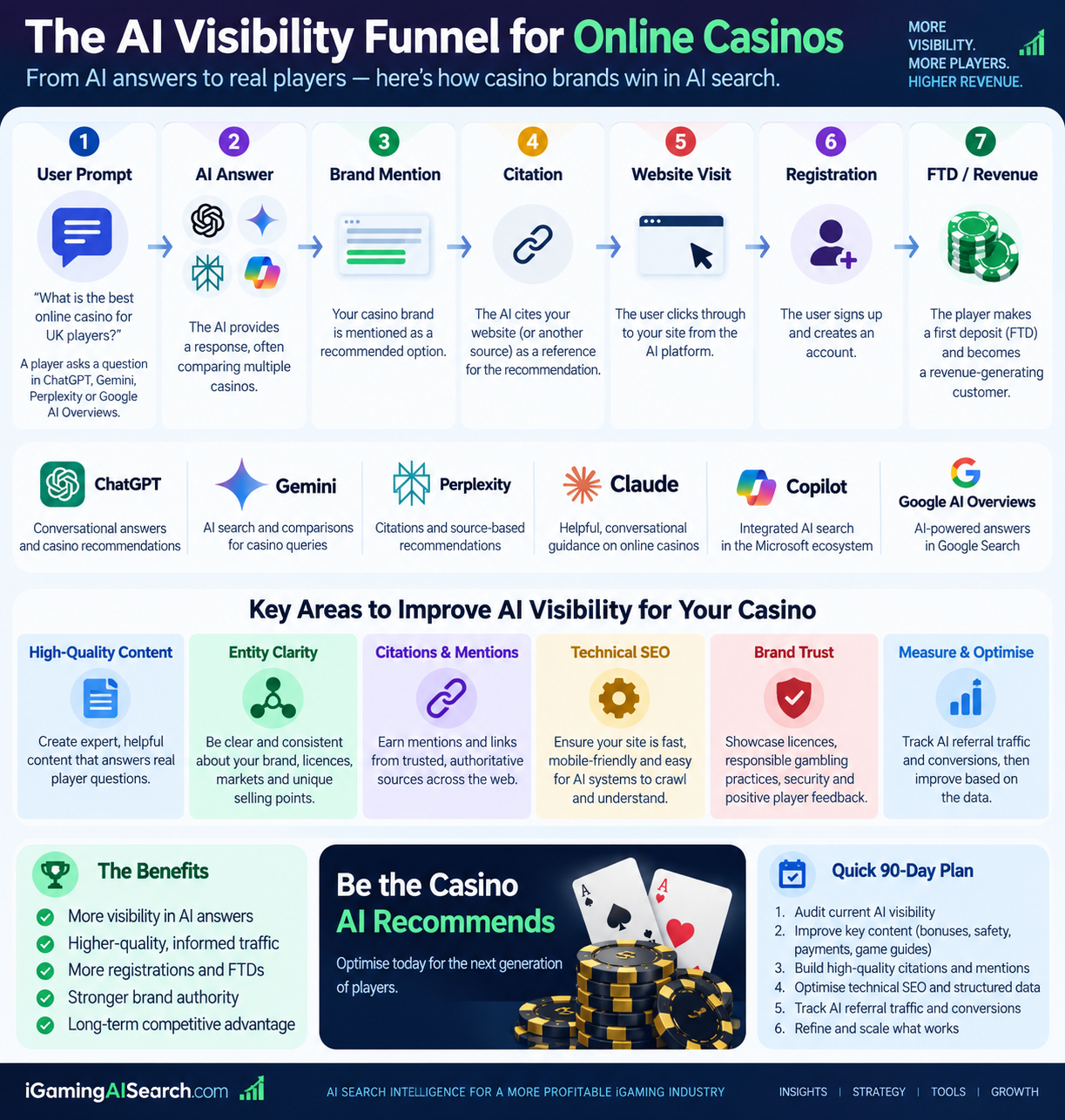
A Practical 90-Day AI Visibility Plan for Casino Operators
Days 1–30: Establish the Baseline
- build a prompt set across brand, discovery, payments, trust and comparison queries;
- measure current mentions, citations, competitors and factual errors;
- audit robots.txt, indexability and important public pages;
- check whether corporate, licensing, payment and country facts are consistent;
- identify the third-party domains most frequently cited for your category.
Days 31–60: Improve Owned Sources
- strengthen high-value payment, withdrawal, licensing and help content;
- consolidate contradictory or outdated information;
- improve internal linking to canonical factual pages;
- publish non-commodity information or first-party data where credible;
- make important country differences explicit.
Days 61–90: Strengthen External Authority and Measure Change
- correct material factual errors in partner resources where appropriate;
- develop legitimate PR or research assets that can earn independent coverage;
- repeat the original prompt set using the same methodology;
- compare citation sources, share of voice and sentiment;
- connect AI referral traffic to registrations and deposits where analytics allows it.
The objective of the first 90 days is not to ‘solve GEO.’ It is to create a measurable system for improving how the casino is represented across AI discovery environments.
Common Casino GEO Mistakes
- Publishing hundreds of thin question pages. More URLs do not automatically create more authority.
- Focusing only on the operator website. AI systems may rely heavily on external sources.
- Ignoring factual conflicts. Licensing, payments and country availability need especially careful maintenance.
- Buying low-quality mentions. Volume is not a substitute for credible third-party authority.
- Chasing special AI markup. There is no universal GEO schema that guarantees inclusion.
- Measuring only branded prompts. Commercial discovery and comparison prompts are often more valuable.
- Reporting mentions without business outcomes. Traffic and conversion measurement should sit beside visibility metrics.
Should Casinos Use an AI Visibility Tool or an Agency?
That depends on the operator’s internal capabilities.
A visibility platform can be enough for teams that already have strong SEO, content, technical and PR resources. The tool provides the measurement layer: prompts, citations, competitors, share of voice and change over time.
An agency may make more sense when the operator needs help interpreting the data, fixing technical issues, restructuring content, developing digital PR, coordinating multilingual markets or building the measurement framework itself.
Before buying either, define the outcome you want to measure. ‘Improve AI visibility’ is too vague. ‘Increase citation share for non-branded casino payment prompts in three priority markets’ is much more actionable.
FAQ: AI Visibility for Online Casinos
What is GEO for online casinos?
Generative Engine Optimization, or GEO, is a term used for work intended to improve how a brand or website appears in generative AI search experiences. For online casinos, this can include technical accessibility, accurate entity information, useful first-party content, external authority, citations and measurement. We treat GEO as an extension of modern search strategy rather than a replacement for SEO.
Can a casino rank in ChatGPT?
There is no single fixed ChatGPT ranking equivalent to a traditional Google position. A casino may be mentioned, recommended or cited depending on the user’s prompt, available sources and the search system’s retrieval process. Visibility therefore needs to be measured across a controlled set of prompts rather than as one ranking.
Does a casino need special AI schema?
No universal special AI schema is required. Google explicitly says there is no special schema.org markup needed to appear in its generative AI features. Existing structured data can still be useful when it accurately represents visible page content.
Should a casino create an llms.txt file?
It can be maintained for systems that choose to use it, but it should not be treated as a ranking requirement. Google says it does not use llms.txt for Google Search. Core crawlability, authoritative information and content quality deserve higher priority.
How can an online casino track AI traffic?
Operators can combine web analytics with AI visibility tools. OpenAI adds utm_source=chatgpt.com to ChatGPT referral links, making those visits identifiable in analytics. Other AI sources may also be detected through referrer or channel data. The ideal measurement model connects AI mentions and citations with referral visits, registrations, deposits and revenue.
What should casino operators optimize first?
Start with factual clarity and measurement. Make sure the casino’s identity, licences, country availability, payment information and important product facts are consistent and crawlable, then establish a baseline across relevant AI prompts. Without that baseline, it is difficult to know whether GEO work is improving anything.
Final Takeaway
AI visibility for online casinos is not about finding a secret prompt format or adding a new file to the server. It is about making the brand easier to verify and harder to misrepresent.
For most operators, the strongest strategy will combine technical SEO, clear first-party facts, non-commodity content, credible third-party authority, prompt-level monitoring and referral analytics.
As AI search matures, the operators with the best visibility may not simply be those with the most content. They may be the brands with the clearest information ecosystem around them.