
Last fact-check:
ChatGPT is now a genuine search and discovery surface for iGaming. Users can ask which online casinos are available in a country, compare sportsbooks, research payment methods, check whether an operator is licensed, or ask for trustworthy affiliate sources — without starting from a traditional search-results page.
For an iGaming business, the practical question is no longer just “Do we rank in Google?” It is also:
- Does ChatGPT mention our brand?
- Does it cite our website?
- Which competing brands and publishers appear instead?
- Can ChatGPT Search crawl our important pages?
- Do those mentions and citations produce measurable traffic or conversions?
This guide explains how we approach ChatGPT visibility for iGaming using current OpenAI documentation, technical accessibility, entity clarity, source authority, prompt tracking and referral analytics.
For the wider multi-platform framework, see our AI Search Optimization for iGaming guide.
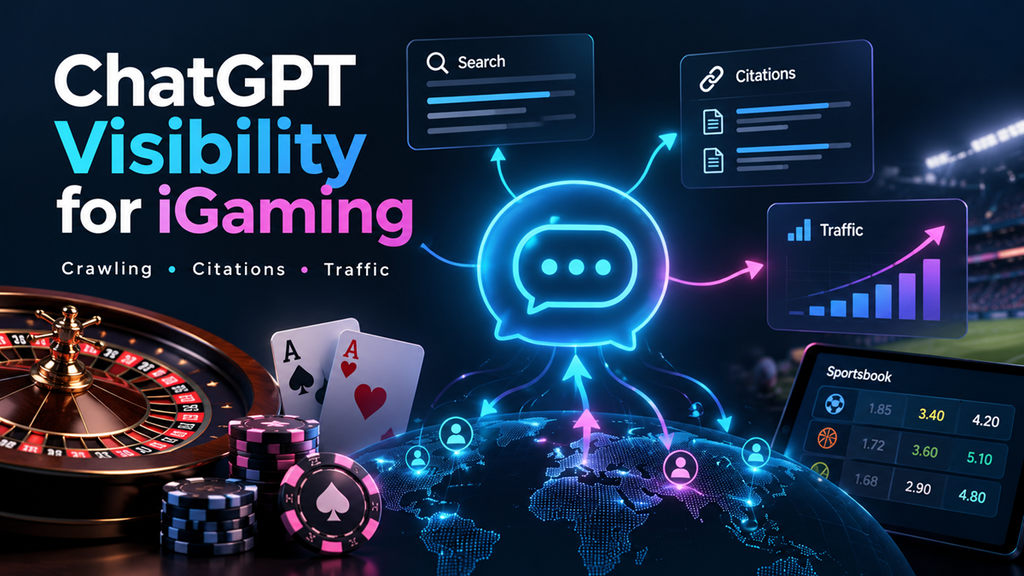
What Does ChatGPT Visibility Mean?
ChatGPT visibility is not one metric. An iGaming brand or website can appear in several different ways.
| Visibility type | Example | What it means |
|---|---|---|
| Brand mention | ChatGPT recommends Casino A | The brand is part of the generated answer |
| First-party citation | ChatGPT links to Casino A’s payment page | The operator website is being used as a source |
| Third-party citation | ChatGPT recommends Casino A but cites Affiliate B | The operator gains recommendation visibility while the affiliate gains source visibility |
| Publisher citation | ChatGPT cites an affiliate review without naming the affiliate in the prose | The publisher still gains source visibility and possible traffic |
| Referral visit | A user clicks the source link | Visibility becomes measurable acquisition traffic |
These outcomes should be tracked separately. A brand can be mentioned frequently but receive few citations, while a publisher may earn citations even when its own brand name rarely appears in the answer.
ChatGPT Search Is Not a Conventional Rank Tracker
OpenAI says ChatGPT Search ranks results using multiple factors intended to help users find relevant and reliable information, but placement is not guaranteed.
That is an important limitation for anyone selling “ChatGPT rankings.” Generated answers can change with prompt wording, user context, location, fresh web results and repeated runs. It is more useful to measure mention frequency, citation frequency, source share and competitive visibility than to pretend there is always one stable position comparable to a conventional Google rank.
OpenAI: Searching the web with ChatGPT
1. Allow OAI-SearchBot if You Want ChatGPT Search Visibility
OpenAI’s current crawler documentation is explicit: OAI-SearchBot is the crawler used to surface websites in ChatGPT’s search features.
If a site opts out of OAI-SearchBot, OpenAI says it will not be shown in ChatGPT Search answers, although navigational links may still appear in some circumstances.
A simple robots.txt rule can allow search crawling:
User-agent: OAI-SearchBot
Allow: /
OpenAI also recommends allowing requests from its published OAI-SearchBot IP ranges. This matters because a site can allow the bot in robots.txt and still block it at Cloudflare, another CDN, a firewall or a bot-protection layer.
OpenAI notes that crawler-control changes can take roughly 24 hours to be reflected by its systems.
2. OAI-SearchBot and GPTBot Are Different
This is one of the most common areas of confusion.
| Crawler | Purpose | Relevant decision |
|---|---|---|
| OAI-SearchBot | Search discovery and surfacing in ChatGPT Search | Allow it if you want search eligibility |
| GPTBot | Crawling that may be used to improve/train OpenAI generative AI foundation models | Can be allowed or blocked independently |
| ChatGPT-User | User-initiated page visits and certain Custom GPT actions | Not the crawler used to determine Search inclusion |
OpenAI explicitly says the settings are independent. A publisher can allow OAI-SearchBot for search while disallowing GPTBot for training.
For example:
User-agent: OAI-SearchBot
Allow: /

User-agent: GPTBot
Disallow: /
This configuration expresses two different choices: allow ChatGPT Search crawling, while opting the site out of GPTBot training crawling.
3. Check More Than robots.txt
A correct robots.txt file does not guarantee that OpenAI can fetch the site.
For iGaming websites, the most common technical blockers can include:
- Cloudflare or another CDN blocking automated requests;
- aggressive bot-protection rules;
- country or IP restrictions;
- JavaScript-only rendering of important content;
- login walls;
- incorrect noindex directives;
- broken canonicals or redirects;
- security rules returning 403 responses.
OpenAI’s own troubleshooting guidance specifically calls out robots.txt, web protection and bot-mitigation systems as separate layers that can block legitimate crawler access.
4. Build Clear, Consistent iGaming Entities
Crawlability gets a page into the pool of information ChatGPT can potentially use. It does not make the brand easy to understand.
For a casino or sportsbook, important entity facts include:
- brand name and official domain;
- legal or operating company;
- licensing authority and licence details;
- countries served or restricted;
- currencies and payment methods;
- sportsbook/casino product coverage;
- official apps;
- support and responsible-gambling information.
These facts should be consistent across the homepage, terms, licensing pages, help centre, country pages, app listings and credible third-party sources.
In iGaming, factual inconsistency is particularly damaging because many high-intent prompts are trust prompts: “Is this casino licensed?”, “Does this sportsbook accept players from my country?”, “Can I withdraw with this payment method?”
5. Create Pages That Answer Specific ChatGPT Questions
ChatGPT users often ask complete questions rather than short keyword fragments. That creates a strong opportunity for pages built around genuine user needs.
Useful iGaming page types can include:
- country-specific casino and sportsbook pages;
- payment-method guides;
- withdrawal and verification help pages;
- sport and league betting pages;
- operator reviews with first-hand evidence;
- comparison pages;
- licensing and ownership information;
- original research and data pages.
The objective is not to manufacture hundreds of pages for imaginary prompts. It is to make important real-world questions easy to answer with accurate, well-supported information.
6. Separate Brand Visibility From Citation Visibility
When ChatGPT recommends an operator, inspect the sources supporting the answer.
If ChatGPT names your casino but cites a competitor affiliate, you have strong brand visibility but weak first-party source visibility. If it cites your affiliate review while recommending a casino, your publisher has citation visibility even though the operator receives the recommendation.
This distinction is especially important for affiliate sites. A publisher does not need to become the answer’s featured brand to benefit from ChatGPT Search. Becoming a useful source can itself create authority and referral traffic.
Our AI Citation Tracking for iGaming guide explains how to measure source share, exact cited pages and competitor citation gaps.
7. Strengthen Third-Party Source Coverage
ChatGPT does not have to rely on the operator’s own site when answering an iGaming question.
Depending on the topic, relevant sources may include:
- regulators;
- affiliate review sites;
- industry media;
- sports organizations;
- payment providers;
- operator help centres;
- forums or community discussions;
- original research sources.
That makes off-site information part of ChatGPT visibility. If third-party pages contain an outdated licence, wrong accepted-country list or old withdrawal policy, improving only the operator website may not fully solve the problem.
Useful actions include correcting outdated coverage, improving affiliate information, publishing legitimate news, earning relevant editorial references and producing original data worth citing. Avoid services that promise guaranteed ChatGPT citations; OpenAI does not provide a paid organic-placement mechanism for publishers.
8. Treat Country and Language as Core Variables
iGaming recommendations are highly geographic.
A casino that is relevant for Canada may not accept players in the UK. A sportsbook may operate legally in one state or country but not another. Bonuses, currencies, payment methods and licensing can all vary by market.
That means “best sportsbook” or “best online casino” should not be treated as one universal ChatGPT prompt.
For international brands, track separate prompt sets by:
- country;
- language;
- product type;
- payment method;
- brand intent versus discovery intent.
This is particularly important for Arabic, multilingual and multi-jurisdiction iGaming websites.
9. Build a Repeatable ChatGPT Prompt Set
Anecdotal screenshots are useful evidence, but they are not a measurement system.
A practical prompt set should include several intent groups:
| Prompt group | Example |
|---|---|
| Brand trust | Is Casino X safe and licensed? |
| Country discovery | What are the best online casinos in Canada? |
| Sportsbook discovery | What are the best sportsbooks for football betting in Nigeria? |
| Payments | Which casinos support PayPal withdrawals? |
| Feature | Which sportsbooks offer cash out and bet builders? |
| Comparison | Casino X vs Casino Y |
| Publisher discovery | Which sites have trustworthy casino reviews? |
Keep the core prompts stable so results can be compared over time. Add new prompts when products or markets change, but do not rebuild the entire benchmark every reporting cycle.
10. Track ChatGPT Mentions and Citations With Visibility Tools
Manual testing is useful for understanding individual answers. Dedicated AI visibility tools are more useful for repeated monitoring.
Depending on the platform, you may be able to monitor:
- brand mention frequency;
- share of voice;
- cited domains and URLs;
- competitor visibility;
- sentiment;
- country and language differences;
- changes over time.
Platforms we currently monitor include Omnia, Peec AI, OtterlyAI, Profound, SE Visible, Semrush AI Visibility, Ahrefs Brand Radar and Writesonic. We have tested Omnia hands-on with iGaming-related use cases.
See our Best AI Visibility & GEO Tools for iGaming comparison and Best AI Tools for iGaming Affiliates.
11. Track ChatGPT Referral Traffic
OpenAI gives publishers a useful measurement signal: ChatGPT referral URLs automatically include utm_source=chatgpt.com.
That means ChatGPT Search traffic can be identified in analytics platforms such as GA4 when the referral information reaches the site.
For affiliates, a useful funnel is:
ChatGPT visit → landing page → operator click → registration → FTD → affiliate revenue
For operators:
ChatGPT visit → landing page → registration → KYC → deposit → player value
Our AI Referral Traffic for iGaming guide explains the GA4 and conversion-attribution setup.
12. Do Not Confuse Search Eligibility With Guaranteed Inclusion
Allowing OAI-SearchBot makes a site eligible for search discovery. It does not guarantee that a page will be cited, recommended or placed prominently.
OpenAI says search placement uses multiple factors intended to help users find relevant and reliable information. It does not publish a simple checklist where completing a fixed number of actions guarantees a citation.
For that reason, we would be cautious with claims such as:
- “submit your site to ChatGPT and rank instantly”;
- “install llms.txt to rank in ChatGPT”;
- “add special ChatGPT schema”;
- “buy guaranteed ChatGPT citations.”
OpenAI’s current publisher and crawler documentation focuses on public accessibility, OAI-SearchBot, crawler controls and referral tracking. We have not found an OpenAI requirement for a special ChatGPT schema or llms.txt file for Search inclusion.
ChatGPT Visibility for Casino Operators
Casino operators should prioritize factual accuracy and market availability.
High-value ChatGPT questions often involve licensing, safety, payments, withdrawals, country availability, game categories, bonuses and support. If those facts are inconsistent between the operator and third-party sources, the problem is larger than conventional SEO.
See our AI Visibility for Online Casinos guide.
ChatGPT Visibility for Sportsbooks
Sportsbooks add a freshness challenge because events, odds, markets and promotions change rapidly.
Separate stable operator facts from time-sensitive betting data, and monitor country, sport, league and feature prompts independently.
See our AI Search Optimization for Sportsbooks guide.
ChatGPT Visibility for iGaming Affiliates
Affiliates should track both recommendation visibility and source visibility.
The operator may appear as the recommendation while the affiliate review becomes the cited source. That means first-hand testing, original data, accurate comparisons, clear update dates and strong country/payment expertise can be commercially useful even when the affiliate’s brand itself is not the main answer.
See our AI Search Optimization for iGaming Affiliates guide.
A 90-Day ChatGPT Visibility Plan
| Period | Priority | Actions |
|---|---|---|
| Days 1–30 | Eligibility and baseline | Check OAI-SearchBot, firewall/CDN access, build prompt set, record mentions/citations and identify competitors |
| Days 31–60 | Facts and content | Fix entity inconsistencies, improve high-value factual pages, country pages and first-hand evidence |
| Days 61–90 | Authority and outcomes | Address citation gaps, improve third-party information, monitor source share and connect referrals with conversions |
Common ChatGPT Visibility Mistakes
- Blocking OAI-SearchBot. This can remove the site from ChatGPT Search answers.
- Assuming GPTBot controls Search. Search and training crawler choices are independent.
- Allowing robots.txt but blocking the crawler at the CDN. Both layers matter.
- Tracking only branded prompts. Discovery prompts show whether you compete for new users.
- Counting mentions as citations. They are different metrics.
- Ignoring third-party sources. Affiliates, regulators and media can shape the answer.
- Ignoring geography. iGaming recommendations can change by country and language.
- Assuming visibility equals traffic. Measure referrals and conversions separately.
- Believing one technical file guarantees ranking. OpenAI does not promise placement.
FAQ
How do I get my iGaming website into ChatGPT Search?
Make the relevant pages public and allow OAI-SearchBot in robots.txt and at the CDN/firewall level. This makes the site eligible for ChatGPT Search discovery, but OpenAI does not guarantee inclusion or placement.
Do I need to allow GPTBot to appear in ChatGPT Search?
No. OpenAI says OAI-SearchBot and GPTBot are separate controls. You can allow OAI-SearchBot for search while disallowing GPTBot for training.
Does ChatGPT use llms.txt to rank websites?
OpenAI’s current publisher and crawler documentation does not state that llms.txt is required for ChatGPT Search inclusion or ranking. The documented control for Search crawling is OAI-SearchBot.
Can I track traffic from ChatGPT?
Yes. OpenAI says ChatGPT referral URLs automatically include utm_source=chatgpt.com, which allows inbound Search traffic to be identified in analytics platforms such as Google Analytics.
Can an iGaming affiliate benefit without being recommended by name?
Yes. An affiliate review or comparison page can be cited as a source while the answer recommends an operator. That is why citation visibility should be tracked separately from brand mentions.
How often should I monitor ChatGPT visibility?
Automated tools can run prompts daily, while strategic reporting can usually be monthly. What matters most is keeping a stable core prompt set so changes are comparable over time.
Final Takeaway
ChatGPT visibility starts with technical eligibility, but it does not end there.
For iGaming, the stronger framework is:
Crawlable → Understandable → Useful → Cited → Clicked → Converted
Allow OAI-SearchBot if you want Search eligibility, keep entity and market facts consistent, create genuinely useful pages, understand which third-party sources influence answers, monitor a stable prompt set and connect citations with referral traffic and commercial outcomes.