
Last fact-check:
An iGaming brand can be visible in an AI answer without its own website being cited. A casino may be recommended while an affiliate review supplies the source link. A sportsbook may be described using a regulator, media article or help-centre page. An affiliate may never be mentioned by name yet still earn valuable citation visibility because its reviews are used as supporting evidence.
That is why AI citation tracking deserves to be measured separately from brand mentions, rankings and referral traffic.
This guide explains how iGaming operators, affiliates and B2B companies can track which domains and pages AI systems cite, compare citation share with competitors, identify source gaps and turn those findings into practical content, PR and authority work.
For the broader measurement framework, start with our AI Visibility Tracking for iGaming guide.
What Is an AI Citation?
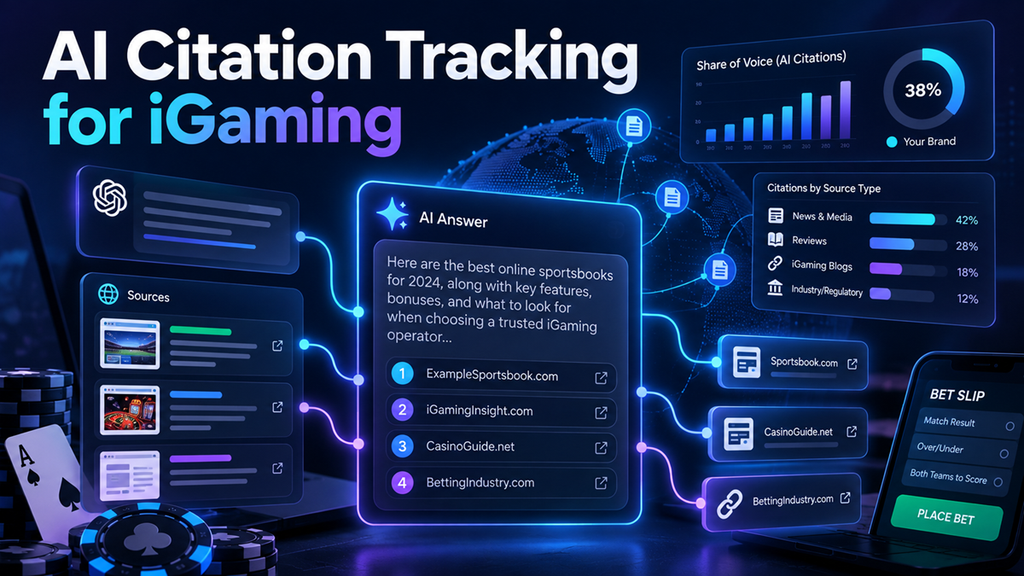
In practical AI Search measurement, a citation is a visible source reference that connects an AI-generated answer to a webpage or domain. Depending on the platform, it may appear as an inline source link, a source card, a footnote-style reference or another linked source element.
Different AI engines present sources differently, and AI visibility tools do not all calculate “citations” in exactly the same way. The safest approach is therefore to track the underlying source itself:
- which domain was cited;
- which exact page was cited;
- which prompt produced the citation;
- which AI engine produced it;
- which market or language was being tested;
- whether your brand was also mentioned;
- whether the citation later generated a measurable visit.
OpenAI says publishers that allow OAI-SearchBot can have content discovered, surfaced and clearly cited and linked in ChatGPT Search. Perplexity says citations have been part of its answers from the beginning. Google now exposes first-party generative-AI performance data in Search Console for AI Overviews and AI Mode, including the pages receiving impressions in those experiences.
OpenAI publisher guidance · Perplexity publisher information · Google Search Console generative AI report
Brand Mentions and Citations Are Different Metrics
This distinction is fundamental.
| Outcome | Example | Who benefits? |
|---|---|---|
| Brand mention only | AI recommends Casino A but links to no source from Casino A | Casino A gains brand visibility |
| Brand mention + third-party citation | AI recommends Casino A and cites Affiliate B’s review | Casino A gains brand visibility; Affiliate B gains source visibility |
| First-party citation | AI cites Casino A’s payment or help page | Casino A gains source visibility and potential referral traffic |
| Publisher citation without publisher mention | AI cites Affiliate B but never names Affiliate B in the prose answer | Affiliate B may still gain authority and traffic |
For affiliates in particular, source visibility may be as important as being named. The operator can receive the recommendation while the affiliate earns the citation and potentially the click.
The AI Citation Tracking Framework
We recommend measuring citation visibility through six layers:
Prompt → AI Answer → Brand Mention → Citation → Referral Visit → Conversion
Each layer answers a different question:
- Prompt: What question was tested?
- Answer: Which brands or recommendations appeared?
- Mention: Was your brand explicitly named?
- Citation: Which domain and page were used as a source?
- Visit: Did the source link generate identifiable traffic?
- Conversion: Did that visit create a lead, registration, deposit or other meaningful outcome?
1. Track Citation Rate
Citation rate is the percentage of relevant tested prompts in which your domain appears as a cited source.
A simple working formula is:
Citation rate = prompts with at least one citation to your domain ÷ total prompts tested
That metric is especially useful when the same prompt set is repeated over time. It tells you whether your domain is becoming more or less common as supporting evidence across the questions that matter to your business.
Do not compare citation percentages blindly between different tools. Prompt sets, answer sampling, engines and calculation methods can differ. Use one stable methodology for trend analysis.
2. Measure Citation Share Against Competitors
Raw citation counts need context. Ten citations may be strong if competitors receive three each, or weak if the category leader receives 80.
For an operator, the comparison set might include:
- your own sportsbook or casino domain;
- three to five direct operator competitors;
- major affiliate publishers;
- regulators or governing bodies;
- large media or information sites.
For an affiliate, the comparison set is usually more publisher-focused: your domain versus competing review, comparison and information sites.
The objective is not merely to “beat” every cited domain. A regulator being cited more frequently than an affiliate for licensing questions is entirely logical. The useful insight is understanding which type of source wins for which type of prompt.
3. Track the Exact Pages That Earn Citations
Domain-level visibility can hide the most useful information.
If your site receives 40 citations, determine whether they come from 30 different pages or one unusually strong article. The answer changes the strategy.
Useful page-level fields include:
- cited URL;
- page type;
- topic or intent;
- country and language;
- AI engine;
- prompt;
- first observed date;
- most recent observed date;
- citation frequency.
Pages that repeatedly earn citations can become models for future content. Look for what makes them unusually useful: original data, precise definitions, clear comparison tables, factual depth, direct answers, strong entity information or unique first-hand evidence.
4. Segment Citations by Prompt Type
Not all citations have equal strategic value.
| Prompt type | Example | Likely useful sources |
|---|---|---|
| Brand trust | Is Casino X safe? | Operator, regulator, affiliate reviews, media |
| Payments | Which casinos support PayPal withdrawals? | Operator payment pages, affiliates, payment providers |
| Sportsbook product | Which sportsbooks offer player props? | Sportsbook product pages, reviews, specialist media |
| Country discovery | Best online casinos in Finland | Affiliates, operators, regulatory information |
| Comparison | Casino A vs Casino B | Comparison sites, reviews, first-party product pages |
| Regulation | Who licenses online casinos in Ontario? | Regulators and official sources |
This segmentation prevents a common mistake: treating every missing citation as something you should try to win. Some queries should naturally be dominated by regulators, sports bodies or other primary sources.
5. Track Citations by Country and Language
iGaming is unusually sensitive to geography. A source that dominates English-language casino prompts in Canada may be almost irrelevant in Finland, Germany, Nigeria or Arabic-speaking markets.
For multi-market operators and publishers, citation tracking should therefore be segmented by:
- country;
- language;
- product type;
- payment method;
- operator brand;
- AI platform.
A single global citation score can hide major local strengths and weaknesses.
6. Monitor New, Lost and Repeated Citations
A useful citation report should show movement, not just totals.
- New citations: pages or domains that appeared for the first time.
- Lost citations: sources that previously appeared but no longer do.
- Repeated citations: sources consistently selected across multiple runs.
- Prompt migration: a citation may disappear from one prompt while appearing for another.
One lost citation is not automatically a problem. AI outputs are variable. A sustained change across repeated runs and a stable prompt set is more meaningful than a single observation.
7. Build a Citation Gap Report
A citation gap is a source opportunity where competitors are repeatedly cited and your site is not.
For each important prompt cluster, record:
- top cited domains;
- top cited pages;
- whether the source is first-party or third-party;
- what information the cited page contains;
- whether you already have an equivalent page;
- whether your information is stronger, weaker or simply different;
- the realistic action needed to close the gap.
This turns an abstract GEO problem into a concrete editorial or authority task.
What to Do After You Find a Citation Gap
Not every citation gap requires new content. The appropriate response depends on why the competitor is being cited.
| Gap | Likely action |
|---|---|
| Your first-party page is missing | Create or improve the relevant factual page |
| Your page is weaker than cited competitors | Add original data, clearer answers, better evidence or more current information |
| Third-party publishers dominate | Strengthen affiliate relations, digital PR and accurate external coverage |
| Regulators dominate | Do not try to replace them; make your own regulatory facts consistent with primary sources |
| Your page exists but is not accessible | Review crawlability, rendering, canonicals and indexing controls |
| Your page is cited but produces no clicks | Improve the value proposition beyond the answer itself |
The important principle is simple: diagnose the source pattern before choosing the tactic.
AI Citation Tracking for Casino Operators
Casino operators should track both first-party and third-party citations.
First-party citation opportunities often include payments, verification, withdrawals, game categories, support, responsible gambling, terms and country-specific availability.
Third-party citations are especially important for trust and comparison prompts. If an AI answer repeatedly relies on affiliate reviews or media coverage to describe your casino, those sources are part of your effective AI reputation footprint.
See our AI Visibility for Online Casinos guide for the operator framework.
AI Citation Tracking for Sportsbooks
Sportsbooks have an additional freshness problem. An AI system may cite pages about product features, event coverage, leagues, rules or payments, but rapidly changing odds and offers can become outdated quickly.
Track which sources appear for relatively stable sportsbook questions separately from highly time-sensitive event or odds questions. That distinction helps prevent stale source data from being interpreted as a general authority problem.
See our AI Search Optimization for Sportsbooks guide.
AI Citation Tracking for iGaming Affiliates
For affiliates, citations are one of the most commercially interesting AI Search metrics because the publisher does not need to be the recommended brand to benefit.
A strong affiliate report should track:
- how often the affiliate domain is cited;
- which reviews and comparison pages earn citations;
- which competing publishers are cited more frequently;
- which operator brands appear in answers citing the affiliate;
- which country and payment prompts generate source visibility;
- whether cited pages receive identifiable AI referral traffic.
For the wider strategy, see our AI Search Optimization for iGaming Affiliates guide and Best AI Tools for iGaming Affiliates comparison.
Which Tools Can Track AI Citations?
Citation and source analysis is now available across several AI visibility platforms, although depth and terminology vary.
Platforms we currently monitor include Omnia, Peec AI, OtterlyAI, Profound, SE Visible, Semrush AI Visibility, Ahrefs Brand Radar and Writesonic. Some focus on prompt-level source extraction, while others combine citation data with brand mentions, share of voice, sentiment or broader SEO workflows.
We have used Omnia hands-on and have seen its Citations view expose domain share of voice, domain ranking and citation counts at both overall and individual-prompt level. Our affiliate tools comparison includes screenshots from that testing.
For the broader software market, see our Best AI Visibility & GEO Tools for iGaming comparison.
Google Search Console as a First-Party Citation Signal
Google now provides a dedicated Generative AI performance report in Search Console for AI Overviews and AI Mode. It shows impressions and allows analysis by pages, countries, devices and dates.
That makes it particularly useful for identifying which of your own pages are being surfaced in Google’s generative AI search experiences. It does not replace cross-platform prompt tracking, and it does not tell you which competitor sources appeared for the same prompt, but it gives you first-party Google data instead of an external estimate.
Google Search Console: Generative AI performance report
Citations Do Not Automatically Equal Traffic
A citation is valuable evidence of source visibility, but it is not the same as a click.
Some answers resolve the user’s question completely. Others create strong reasons to visit the source for details, tools, data, reviews or current information.
OpenAI says ChatGPT referral URLs include utm_source=chatgpt.com, which means publishers can identify inbound ChatGPT Search traffic in analytics platforms such as Google Analytics. That lets you connect citation visibility with real visits where clicks occur.
The next layer in this Tracking cluster is our dedicated AI Referral Traffic for iGaming guide, covering GA4, landing pages, conversions and revenue attribution.
A Practical Monthly AI Citation Report
A useful monthly report can stay relatively compact:
- total monitored prompts;
- citation rate;
- citation share versus named competitors;
- top cited domains;
- top cited pages;
- new citations gained;
- citations lost across repeated runs;
- strongest prompt clusters;
- largest citation gaps;
- AI referral traffic from cited pages where measurable;
- three to five priority actions.
Keep the core prompt set stable from month to month. Citation data becomes much more useful when it is comparable over time.
Common AI Citation Tracking Mistakes
- Counting brand mentions as citations. They are different outcomes.
- Tracking domains but not pages. Page-level evidence often reveals the real content opportunity.
- Ignoring prompt type. Regulatory and commercial queries naturally use different sources.
- Ignoring geography. Source ecosystems can change completely between markets.
- Overreacting to one lost citation. AI outputs vary; look for repeated change.
- Assuming every citation is equally valuable. Commercial relevance matters.
- Buying PR before diagnosing the gap. First determine why another source is being selected.
- Stopping at citations. Track referral visits and conversions where possible.
FAQ
What is AI citation tracking?
AI citation tracking measures which domains and pages AI-generated answers use as visible supporting sources for a defined prompt set. It is different from tracking whether a brand is merely mentioned.
Can an affiliate be cited without being mentioned?
Yes. An AI answer may recommend an operator while linking to an affiliate review or comparison page as a source. That is why affiliates should monitor citation visibility separately from brand visibility.
Can Google Search Console show AI citations?
Google’s dedicated Generative AI performance report shows impressions for your pages in AI Overviews and AI Mode and can be broken down by page, country, device and date. It is best treated as first-party visibility data for Google’s own generative AI features rather than a complete cross-engine citation tracker.
Which AI engines should an iGaming site monitor?
For most international iGaming businesses, the practical starting set is ChatGPT, Google AI features, Gemini and Perplexity, with additional platforms added when the audience or market justifies them.
How often should citation tracking be run?
Frequent automated monitoring can be useful, but monthly strategic reporting is usually enough to identify meaningful patterns. The key is consistency: use the same prompt set, markets and methodology so changes can be interpreted.
Final Takeaway
AI citations tell you something brand mentions cannot: which sources AI systems appear willing to use as evidence.
For iGaming operators, that reveals the external information ecosystem shaping the brand. For affiliates, it reveals whether reviews and comparison pages are becoming sources. For both, it creates a practical way to identify content, authority and technical gaps.
Track citations by prompt, page, country, language and engine; compare against appropriate competitors; distinguish sustained changes from normal output variation; and connect citation visibility to referral traffic and conversions whenever possible.