Last fact-check:
Testing disclosure: iGaming AI Search tested Search Atlas during its 7-day trial on two real iGaming websites: one affiliate site and one casino/sportsbook site. Our test focused on AI Visibility, Atlas Agent and Playbooks, market setup, prompt tracking, competitor analysis, citations, sentiment, source analysis and Prompt Simulator. During our signup flow, a payment card was requested for the trial, although nothing was charged at signup. Search Atlas also offered a free 1:1 onboarding session. We participate in the Search Atlas affiliate program and may earn a commission if you subscribe through links on this page. Commercial relationships do not determine our conclusions.
Search Atlas is much broader than a dedicated AI visibility tracker. It combines traditional SEO tooling, AI search monitoring, automated SEO execution, content workflows, technical SEO, reporting and an AI agent inside one platform. That breadth is its biggest strength – and, in our experience, also one of its biggest drawbacks.
After testing it on both an affiliate website and a casino/sportsbook site, our view is that Search Atlas is one of the most ambitious AI SEO automation platforms we have tried, but it is not the easiest platform to learn. The AI Visibility product is useful, Atlas Agent is genuinely interesting, and country coverage was broad. However, the interface felt busy, the number of tools can be overwhelming, and the language choices available during our test were too limited for some of our multilingual iGaming projects.
Search Atlas AI Review: Our Verdict
| Best for | SEO teams and agencies that want AI visibility plus broader SEO automation in one platform |
| Hands-on tested? | Yes – 7-day trial |
| iGaming sites tested | 2: one affiliate + one casino/sportsbook |
| AI Visibility on Growth | ChatGPT, Gemini and Google AI Mode in the plan screen we tested |
| Trial | 7 days; card requested in our signup flow |
| Onboarding | Free 1:1 onboarding session offered |
| What we liked most | Broad SEO automation, Atlas Agent, Prompt Simulator, competitor/citation data, many country options |
| Main drawbacks | Busy interface, learning curve, limited language choices in our test, dark UI not to our taste |
| Overall view | Powerful all-in-one AI SEO platform; less simple than specialist AI visibility tools |
What Is Search Atlas AI?
Search Atlas is an SEO and digital marketing platform that now places AI automation at the centre of its product. Searchers use phrases such as Search Atlas AI, Search Atlas AI SEO, Search Atlas AI tools, Search Atlas AI automation and Search Atlas AI SEO software, but these terms generally refer to different parts of the same Search Atlas ecosystem.
The main AI-related components we found relevant were:
- Atlas Agent – a conversational AI agent designed to plan and execute marketing and SEO workflows;
- AI Visibility / QUEST – brand monitoring across AI answer engines;
- OTTO SEO – automated SEO recommendations and execution;
- Content Genius and AI content tools – content creation and optimization workflows;
- Prompt Simulator – prompt-level AI visibility investigation;
- Playbooks – repeatable agent workflows for tasks such as content, technical SEO and AI-search improvement.
Search Atlas describes Atlas Agent as a conversational AI SEO agent that can work across SEO, content, technical optimization, authority, reporting and AI search visibility, with approval controls for changes. See the current Atlas Agent documentation.
For a broader view of competing products, see our Best AI Visibility & GEO Tools for iGaming comparison.
Our Search Atlas Test
We tested Search Atlas on two real iGaming businesses rather than setting up a fictional SaaS domain:
- 1 affiliate website – useful for measuring whether publisher pages, reviews and payment content appeared in AI answers and citations;
- 1 casino/sportsbook website – useful for direct brand visibility, competitor monitoring and prompt-level brand responses.
Our review focused primarily on the AI-search side of Search Atlas rather than attempting to test every SEO feature in the platform. That distinction matters because Search Atlas contains a very large number of tools. A seven-day trial is enough to form a useful view of onboarding, AI Visibility, prompt tracking and the agent workflow, but not enough to validate every part of its SEO automation stack over a long period.
Onboarding and Setup
The onboarding workflow asks which website you want to work on, your market location, language and primary goal. For our test, we could select a goal specifically focused on showing up in AI answers.
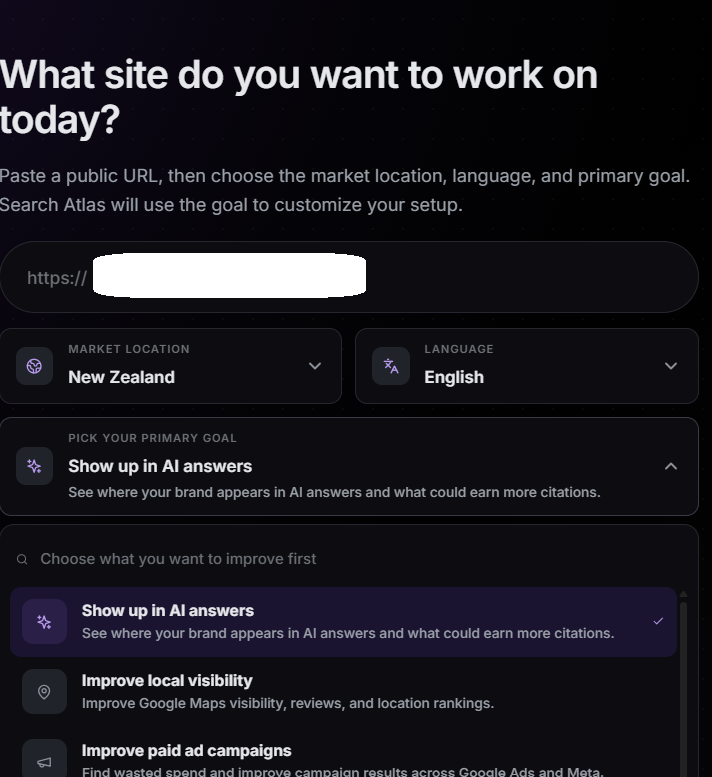
Search Atlas then suggested topics and keywords to track and offered both traditional rank tracking and AI-answer tracking. This is useful because it puts SEO and AI visibility into the same setup flow rather than treating them as unrelated products.
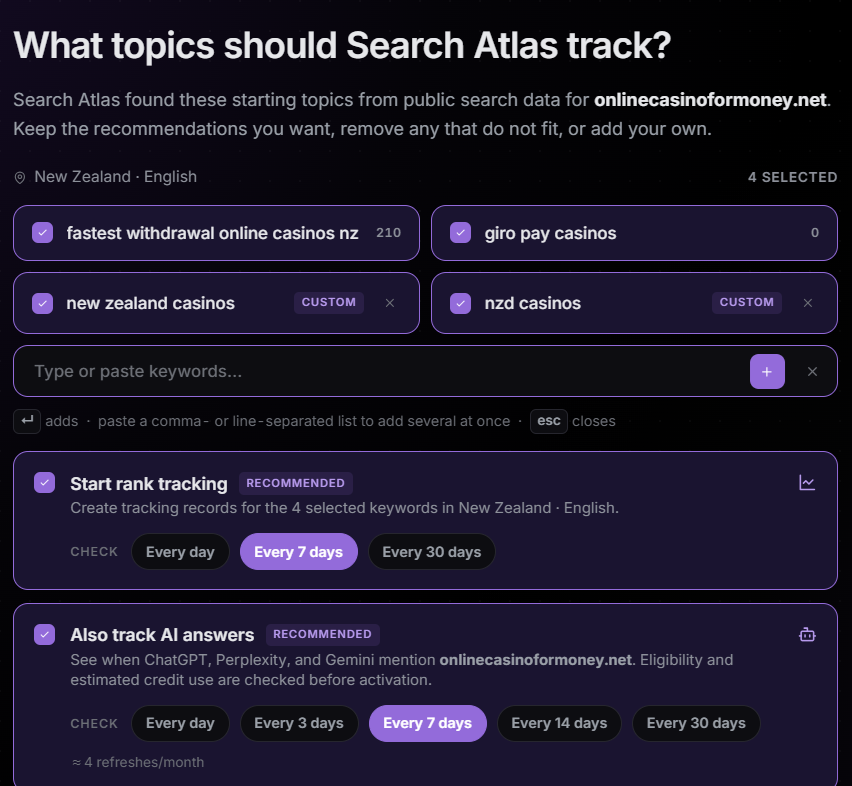
We also liked that Search Atlas offered a free 1:1 onboarding session. For this product, that makes sense: the platform is considerably more complex than a simple prompt tracker.
Country Coverage Was Stronger Than Language Coverage
Geographic targeting was one of the stronger areas in our test. Search Atlas offered a wide selection of countries, which is important for iGaming because brand visibility can change dramatically by market.
However, the language selector was much more restrictive in our test. We could not select Arabic or Russian, for example. That is a meaningful limitation for us because several of our iGaming projects target Arabic-speaking markets and multilingual audiences.
We therefore recommend checking both the country and language selectors before subscribing if your AI visibility strategy depends on less commonly supported languages.
Search Atlas AI Visibility Dashboard
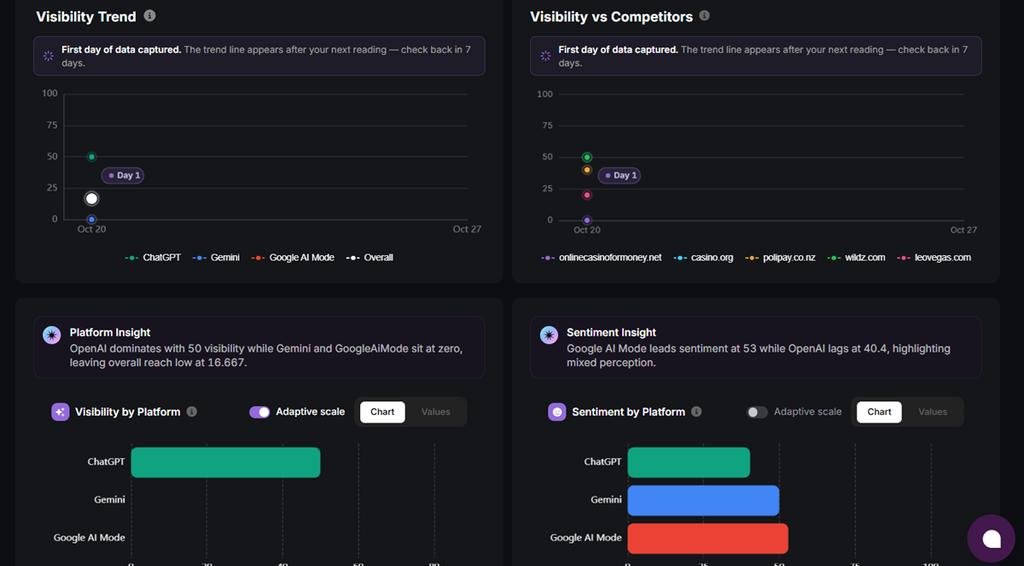
The AI Visibility dashboard was one of the most useful parts of Search Atlas for our work.
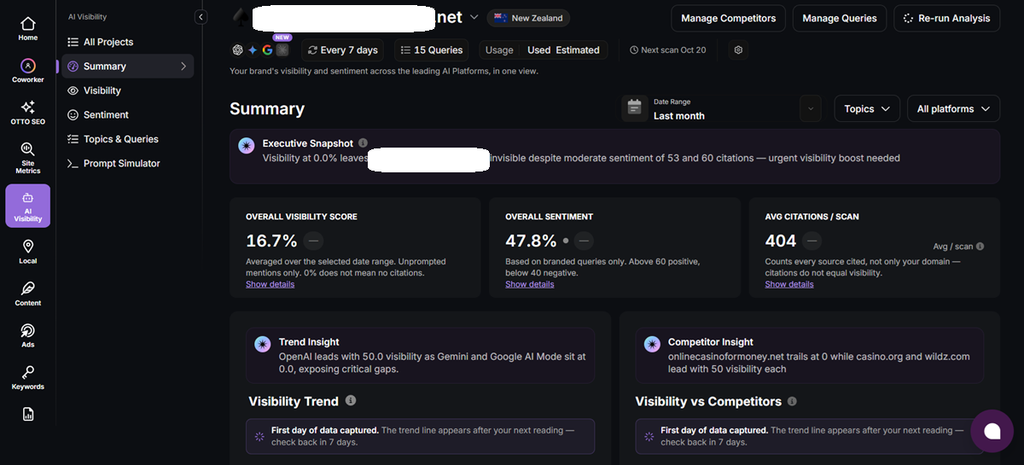
For each project, the platform can show metrics such as:
- overall AI visibility score;
- visibility by platform;
- brand mentions;
- share of voice;
- average brand position;
- competitors appearing in AI responses;
- sentiment;
- common citation domains;
- cited pages;
- visibility trends over time.
Search Atlas’s current AI Visibility documentation defines its core metrics around rank, a position-weighted visibility score, citations and share of voice. See Search Atlas AI Visibility.
Model Responses and Prompt-Level Analysis
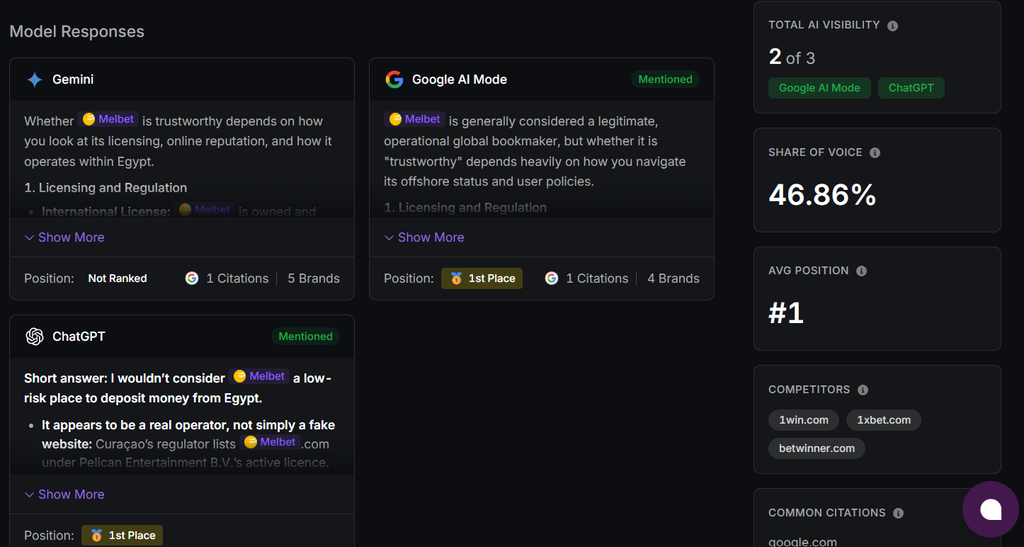
We liked being able to move beyond an overall score and inspect the actual model responses.
For an operator-related query in our test, Search Atlas displayed responses from Gemini, Google AI Mode and ChatGPT side by side. The dashboard then summarized whether the brand was mentioned, its position, share of voice, competitors and citation patterns.
That is important for iGaming. A single visibility score can hide the reason behind a result. Reading the response lets us see whether a casino is being described positively, cautiously or negatively, whether a competitor is recommended first, and which external sources appear to influence the answer.
Sentiment Tracking
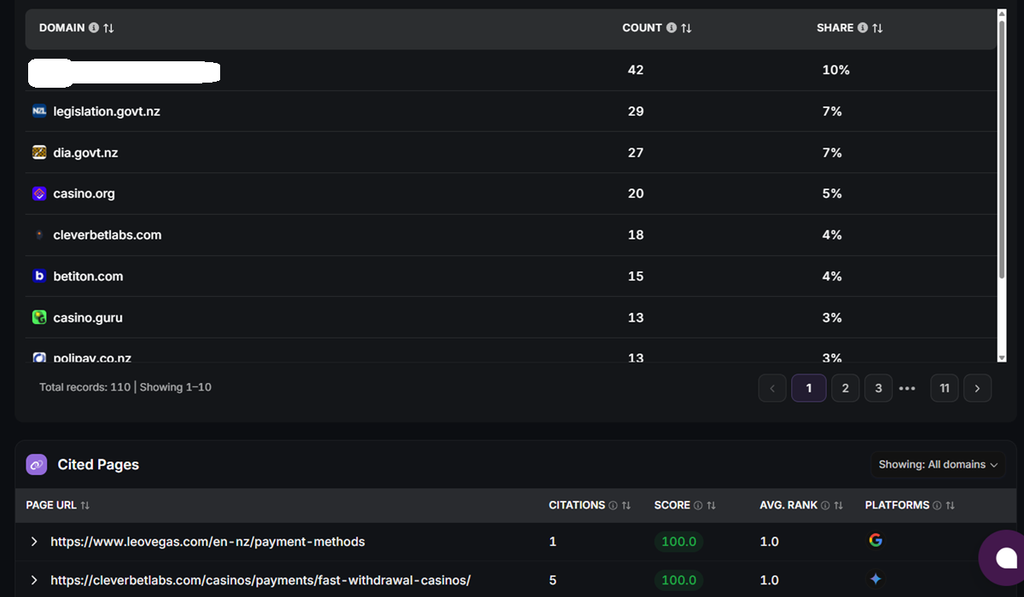
Search Atlas also separates visibility from sentiment. We think that distinction is useful.
A casino or sportsbook can be highly visible in AI answers for the wrong reasons. Search Atlas’s sentiment view can classify monitored responses as positive, neutral or negative and show differences by platform and topic.
Because our test covered only the first data cycle of a seven-day trial, we do not consider our sample large enough to judge long-term sentiment accuracy. The dashboard itself, however, is useful for identifying prompts that deserve manual review.
Citation and Source Analysis
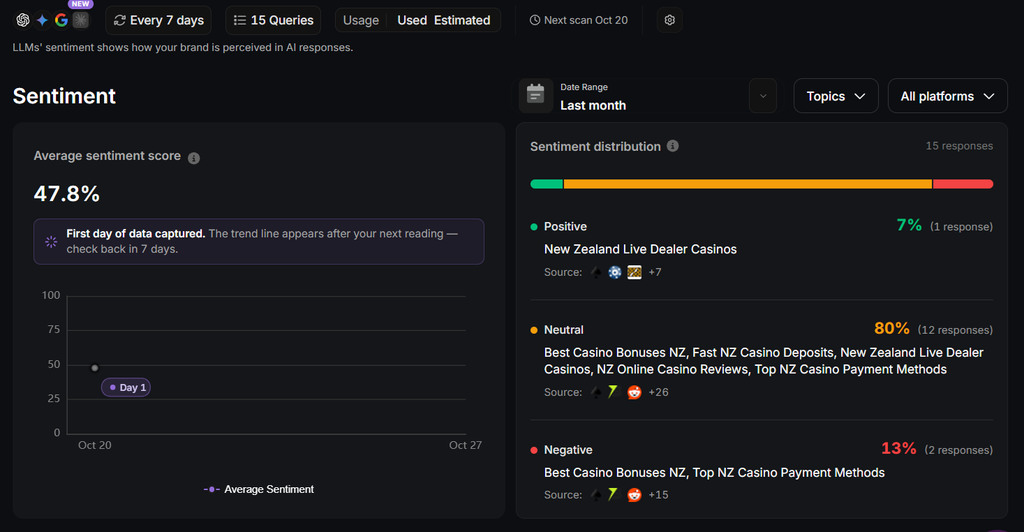
The source reporting is particularly relevant for iGaming affiliates.
Search Atlas shows citation domains, citation counts, share and the individual pages appearing as sources. In our New Zealand-focused test, the source list included government sites and established gambling publishers alongside commercial pages.
This answers a strategically different question from “Does my brand appear?” It helps us investigate which pages and domains AI systems appear to trust when answering the monitored prompts.
For more on measuring this separately, see our AI Citation Tracking for iGaming guide.
Prompt Simulator
We also tested Prompt Simulator.
This is useful when you want to investigate how a specific question behaves without relying only on the high-level dashboard. For iGaming teams, that can help with prompts around operator trust, payment methods, bonuses, country availability and comparative recommendations.
We would still manually check important prompts in the underlying AI products when making editorial or compliance decisions. Like every AI monitoring platform, Search Atlas is an observation layer, not a guarantee that every user will receive an identical answer.
Search Atlas AI Agent: What Is Atlas Agent?
Atlas Agent is the feature that makes Search Atlas materially different from many dedicated AI visibility trackers.
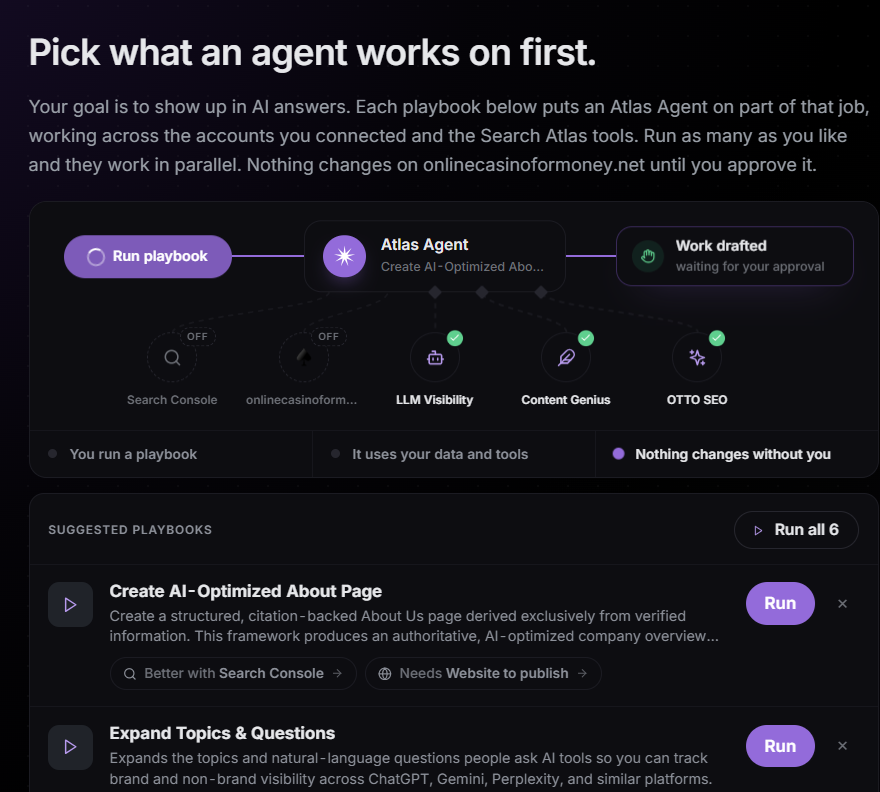
Instead of stopping at “your visibility is low,” the agent is designed to work on marketing tasks. During onboarding we were shown suggested Playbooks such as creating an AI-optimized About page and expanding topics and questions.
The workflow also made the approval boundary clear: Search Atlas can draft work and connect multiple parts of its stack, while changes can wait for user approval rather than silently publishing to the site.
Search Atlas’s current documentation says Atlas Agent can execute workflows across on-page SEO, technical SEO, content, authority, reporting and AI search visibility, and can use pre-built or custom Playbooks. That makes the term Search Atlas AI agent more than a generic chatbot label.
Does Search Atlas Have AI SEO Automation Features?
Yes. Search Atlas has extensive AI SEO automation features. In fact, automation is one of the main reasons to consider the platform rather than buying a standalone AI visibility tracker.
The current automation stack combines Atlas Agent, OTTO SEO, AI content tools and Playbooks. Search Atlas positions Atlas Agent as a system that can move from a plain-language goal to planned actions and deployable outputs, while Playbooks turn recurring processes into standardized workflows.
Examples of the types of work Search Atlas can automate or assist with include:
- SEO strategy and prioritization;
- technical and on-page issue detection;
- metadata and internal-link improvements;
- content planning, generation and optimization;
- topic expansion;
- AI visibility monitoring and improvement workflows;
- reporting;
- selected authority and digital PR workflows.
This is why the Ahrefs query “does Search Atlas have AI SEO automation features?” has a straightforward answer: yes, AI-driven execution is now central to the product rather than an add-on.
Search Atlas AI SEO Automation: What We Liked
The strongest idea behind Search Atlas is that measurement and execution sit in the same ecosystem.
A specialist AI visibility platform may tell you that a competitor is winning a topic or citation. Search Atlas is trying to go further by connecting visibility data to content, technical SEO and agent workflows that can work on the underlying problem.
For an agency or a team already doing substantial SEO work, that integration can save context switching. It also creates a clearer path from:
Visibility problem → diagnosis → Playbook/agent action → approval → implementation → measurement.
That is a compelling model, particularly as AI visibility becomes part of ordinary SEO rather than a separate discipline.
The Interface Felt Busy and Complicated
This was our main usability criticism.
Search Atlas contains many tools and workflows, and the interface reflects that. There are sections for projects, AI visibility, OTTO SEO, content, local, ads, keywords, site metrics, Atlas Agent and more.
We found the platform busier and more complicated than Omnia or OtterlyAI. A user who only wants to track 20–50 AI prompts may find Search Atlas excessive. The free onboarding session is therefore not merely a nice extra; for some users it may materially shorten the learning curve.
We also did not particularly like the predominantly dark interface. That is subjective rather than a product defect, but when working inside a dashboard for long periods we found the dark color scheme less comfortable than lighter interfaces.
Search Atlas Pricing
At our latest fact-check, Search Atlas’s standard monthly pricing was:
| Plan | Monthly | Annual equivalent | AI Visibility |
|---|---|---|---|
| Starter | $99/month | $79/month | No LLM Visibility projects listed in the current plan table |
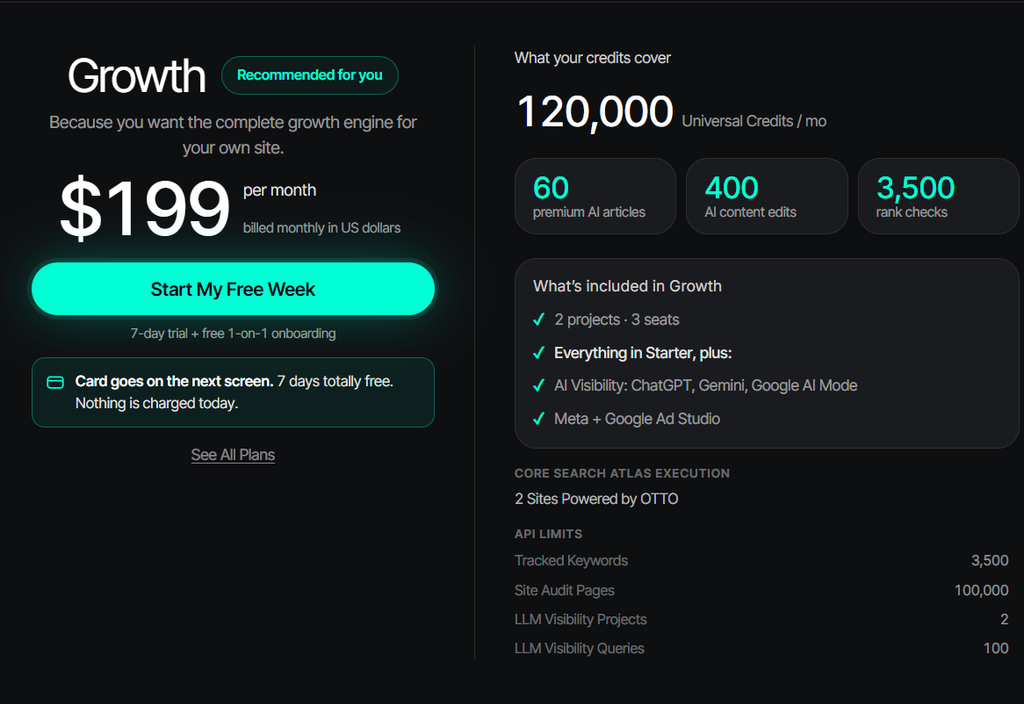
| Growth | $199/month | $159/month | Yes; 2 LLM Visibility projects and 100 queries in the plan screen we checked |
| Pro | $399/month | $319/month | Expanded AI/LLM coverage and higher capacity |
| Agency / Enterprise | From $999/month billed annually | Custom / scaled capacity | Portfolio-level capacity |
The Growth plan shown during our test included 120,000 Universal Credits per month, two projects, three seats, 3,500 tracked keywords, up to 100,000 site-audit pages and AI Visibility for ChatGPT, Gemini and Google AI Mode.
Search Atlas currently offers a 20% discount for annual billing. Because its packaging and credit system have changed over time, we recommend checking the current Search Atlas pricing page before subscribing.
Search Atlas 7-Day Trial
We tested Search Atlas through its 7-day trial. Search Atlas currently promotes a seven-day trial and includes a free 1:1 onboarding session with Growth.
One difference from OtterlyAI is that Search Atlas asked us for card details during signup. The trial screen stated that nothing would be charged that day and that billing would begin after the free week unless cancelled.
If avoiding card entry is important to you, this is worth knowing before you start the signup process.
Search Atlas vs Omnia for AI Visibility
Search Atlas and Omnia overlap on AI visibility, prompts, competitors and citations, but they feel like very different products.
| Area | Search Atlas | Omnia |
|---|---|---|
| Core positioning | All-in-one SEO and marketing automation platform | Dedicated AI visibility and action platform |
| Ease of use | More complex in our test | Simpler and more focused |
| AI agent | Atlas Agent covers broad marketing/SEO execution | Omnia Agent focuses more directly on AI visibility recommendations |
| Traditional SEO tools | Much broader | Not the core product |
| Competitor setup | Useful, but part of a larger workflow | We liked Omnia’s AI-visibility competitor setup more |
| Language flexibility | Limited in our test | Better fit for our multilingual projects |
| Our preference for pure AI visibility | Strong, but complex | Omnia |
| Our preference for all-in-one SEO automation | Search Atlas | Not designed for this breadth |
If your main goal is dedicated AI visibility monitoring, we still preferred Omnia after our hands-on tests. If you want AI visibility embedded inside a much larger SEO automation system, Search Atlas is considerably broader.
Read our hands-on Omnia AI review.
Search Atlas vs OtterlyAI
OtterlyAI sits at almost the opposite end of the complexity spectrum. Its lower-cost plans and focused AI visibility/GEO audit workflow make it easier to understand, while Search Atlas offers much more automation and traditional SEO functionality.
We liked OtterlyAI’s Content Checker more than any directly comparable Search Atlas feature we tested, but Search Atlas offers a much broader execution layer through Atlas Agent and OTTO SEO.
For a small affiliate wanting straightforward AI monitoring and GEO audits, OtterlyAI may be easier. For an agency or SEO-heavy team wanting one platform to perform a much larger set of tasks, Search Atlas makes more sense.
Read our hands-on Otterly AI review.
Search Atlas vs Semrush for AI SEO Automation
This is an increasingly relevant comparison, but we should be precise: our Search Atlas conclusions here are hands-on, while this is not yet a hands-on Semrush head-to-head test. The comparison below is based on the current product positioning and documented feature sets.
Semrush now combines traditional SEO data with AI visibility, prompt tracking, sentiment, competitor research, AI-search health auditing and content recommendations. Search Atlas also combines SEO and AI visibility, but places greater emphasis on agentic execution through Atlas Agent, OTTO SEO and Playbooks.
In practical terms:
- Search Atlas is particularly interesting if you want an AI agent to turn SEO goals into workflows and deployable actions.
- Semrush remains especially strong for teams that already rely on its large SEO datasets, competitive research and reporting ecosystem and want AI visibility added to that stack.
We would not declare a winner until we have tested Semrush’s current AI stack in the same way we tested Search Atlas.
What We Liked
- Very broad product: AI visibility is connected to SEO, content and execution rather than isolated in one dashboard.
- Atlas Agent: one of the more ambitious agentic SEO implementations we have tested.
- Prompt Simulator: useful for investigating specific iGaming questions.
- Strong visibility reporting: mentions, share of voice, position, sentiment, competitors and citations are all useful.
- Source/citation analysis: particularly valuable for affiliates trying to understand which publishers and pages influence AI answers.
- Wide country selection: better geographic flexibility than some specialist tools we tested.
- 1:1 onboarding: genuinely useful given the size of the platform.
- Approval-based workflows: agent output can be reviewed before high-impact site changes are deployed.
What We Didn’t Like
- The interface is busy. There are many products, navigation areas and workflows to learn.
- It felt more complicated than specialist visibility tools. Users who only want AI monitoring may not need this much software.
- Language options were limited in our test. Arabic and Russian were not available in the language selector we saw.
- We did not like the dark visual theme. This is subjective, but we found it less comfortable for long dashboard sessions.
- The trial required card details in our signup flow. OtterlyAI, by contrast, did not require a card for the trial we tested.
- Seven days is short for such a large platform. We could evaluate AI visibility and core workflows but not every SEO automation feature properly.
Who Should Use Search Atlas?
We think Search Atlas is particularly relevant for:
- SEO agencies that want AI visibility and execution in the same platform;
- iGaming affiliate businesses that already do substantial SEO and content production;
- operators with in-house SEO teams that want to connect AI visibility to broader organic-search workflows;
- teams interested in agentic SEO rather than monitoring alone;
- users who value automation and are willing to accept a steeper learning curve.
It is less compelling for a very small publisher that only wants to check a few prompts and citations. For that use case, a simpler specialist such as OtterlyAI may be sufficient.
Is Search Atlas Worth It for iGaming?
Potentially yes – especially for SEO-heavy affiliates, operators and agencies – but it depends on whether you will use the wider automation stack.
Search Atlas is harder to justify if you only want AI visibility monitoring. Growth currently costs $199/month on monthly billing, and the platform contains far more than prompt tracking.
But if you need traditional SEO, content workflows, technical optimization, AI visibility and agentic execution together, the value proposition becomes much stronger. The platform is trying to replace several separate tools and manual workflows rather than compete only with an AI rank tracker.
For our own iGaming work, we would choose Omnia over Search Atlas for a focused AI visibility project. We would choose Search Atlas when the requirement expands to AI visibility + SEO execution + content + technical optimization + automation.
Start the Search Atlas trial →
What is Search Atlas AI?
Search Atlas is an SEO and marketing platform with AI visibility tracking, Atlas Agent, OTTO SEO, AI content tools and automated Playbooks. It combines AI-search measurement with broader SEO execution rather than operating only as an AI visibility tracker.
Does Search Atlas have AI SEO automation features?
Yes. Search Atlas uses Atlas Agent, OTTO SEO and Playbooks to automate or assist with SEO strategy, technical optimization, on-page changes, content, internal linking, reporting and AI visibility workflows.
What is Search Atlas AI Agent?
Atlas Agent is Search Atlas’s conversational marketing and SEO agent. It can interpret a goal, plan workflows, use Search Atlas tools and prepare or execute work across SEO, content, authority, reporting and AI visibility, with approval controls for higher-impact changes.
Does Search Atlas track AI visibility?
Yes. Search Atlas AI Visibility tracks metrics including mentions, brand rank, visibility score, share of voice, citations, competitors and sentiment. The Growth plan screen we tested included ChatGPT, Gemini and Google AI Mode.
How much does Search Atlas cost?
At our latest check, standard monthly pricing was $99 for Starter, $199 for Growth and $399 for Pro. Annual billing reduces the effective monthly prices to $79, $159 and $319 respectively. AI Visibility is included from Growth in the current plan structure.
Does Search Atlas offer a free trial?
Yes. Search Atlas currently offers a seven-day trial. In our signup flow a payment card was required, with the trial screen stating that nothing would be charged immediately. A free 1:1 onboarding session was also offered.
Is Search Atlas better than Semrush for AI SEO automation?
Search Atlas currently places more emphasis on agentic execution through Atlas Agent, OTTO SEO and Playbooks, while Semrush combines a large established SEO data stack with AI visibility, prompt tracking and optimization features. We have not yet completed a comparable hands-on Semrush test, so we would not name a definitive winner yet.
Is Search Atlas better than Omnia?
For pure AI visibility work, we preferred Omnia because it was simpler and more focused for our iGaming projects. Search Atlas is much broader and becomes more attractive when you also want traditional SEO, content, technical optimization and automated execution.
Final Verdict
Search Atlas is not the simplest AI visibility tool we have tested, but it may be the most ambitious.
Its AI Visibility dashboards provide useful data around mentions, competitors, sentiment and citations, while Atlas Agent and Playbooks push the platform toward actual SEO execution rather than reporting alone. That broader vision is compelling.
The trade-off is complexity. We found the interface busy, the dark design less comfortable than alternatives, and the language selection too restrictive for some of our multilingual iGaming work. A seven-day trial also feels short for a platform this large.
For a small team that only wants AI visibility, we would choose something simpler. For an SEO-heavy iGaming business or agency that wants AI search monitoring plus automation across the wider SEO workflow, Search Atlas is one of the more interesting products we have tested.