Last fact-check:
Gemini visibility for iGaming is more complicated than it first appears because Google operates more than one AI surface.
A casino, sportsbook or affiliate may appear in Gemini Apps, in Google AI Overviews, in Google AI Mode, or across several of these environments — and the technical controls are not identical.
That means iGaming teams should not treat “Gemini SEO” as one simple ranking problem. The practical questions are:
- Does Gemini mention our brand?
- Does Gemini show our website as a source or related link?
- Which competing operators or publishers appear instead?
- Does Google Search surface our pages in AI Overviews or AI Mode?
- What does Google-Extended actually control?
- Can we measure Gemini and Google AI referral traffic separately?
This guide explains how we approach Gemini visibility for iGaming, including Google-Extended, Googlebot, source visibility, country and language segmentation, prompt tracking, Search Console and referral analytics.
For the broader multi-platform framework, see our AI Search Optimization for iGaming guide.
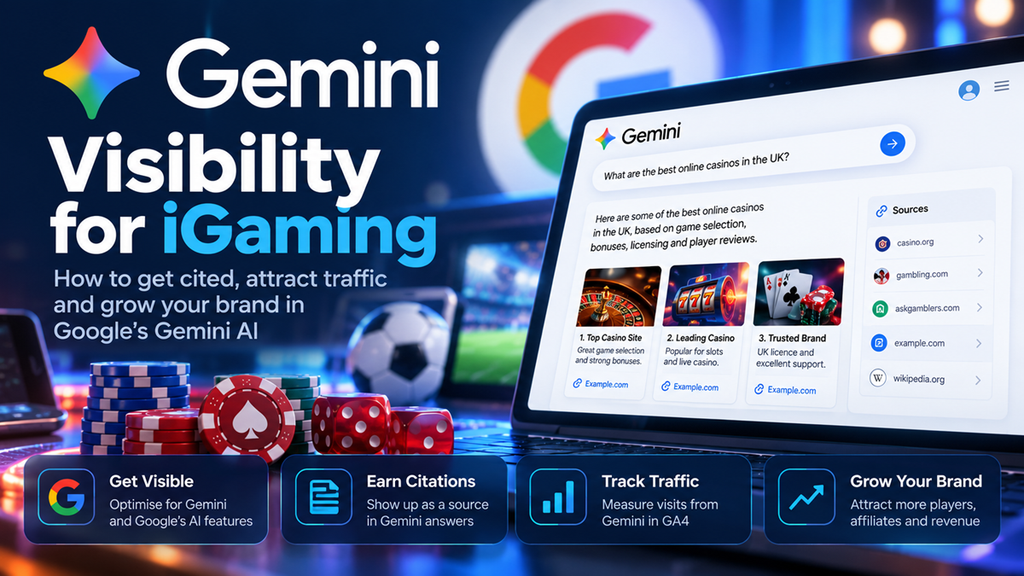
Gemini Apps and Google AI Search Are Different Surfaces
This distinction should come first because it affects both optimization and measurement.
| Surface | What it is | Main control / measurement |
|---|---|---|
| Gemini Apps | Google’s conversational AI experience | Google-Extended influences use of crawled content for Gemini training/grounding; Gemini may show sources and related links |
| Google AI Overviews | Generative answers inside Google Search | Normal Google Search crawling/indexing; Search Console generative AI reporting |
| Google AI Mode | Conversational/generative Search experience | Normal Google Search foundations; Search Console generative AI reporting |
Google explicitly states that the Google-Extended product token does not affect inclusion in Google Search and is not used as a Google Search ranking signal.
Google: Google-Extended documentation
What Does Gemini Visibility Mean?
Gemini visibility can involve several distinct outcomes.
| Visibility type | Example | What it means |
|---|---|---|
| Brand mention | Gemini recommends Casino A | The brand appears in the response |
| Source / related link | Gemini links to Casino A or an affiliate review | The website gains source visibility |
| Google AI Search visibility | A page appears in AI Mode or an AI Overview | The site is visible in Google’s generative Search surfaces |
| Third-party influence | Gemini describes Casino A using regulator or affiliate information | External sources are shaping the answer |
| Referral visit | A user clicks a source or related link | Visibility becomes measurable traffic |
Do not collapse these into one “Gemini ranking.” Brand mentions, source visibility, Google AI Search impressions and actual referral visits answer different questions.
1. Understand What Google-Extended Controls
Google-Extended is a robots.txt product token, not a separate crawler user-agent string. Google says crawling still happens through existing Google user agents; the Google-Extended token is used as a control.
Google currently says Google-Extended can be used to manage whether content Google has crawled may be used:
- to help train future generations of Gemini models powering Gemini Apps;
- for the Vertex AI API for Gemini;
- for grounding in Gemini Apps;
- for Grounding with Google Search on Vertex AI.
A basic allow rule looks like:
User-agent: Google-Extended
Allow: /
A site that does not want its content used in those Google-Extended contexts can disallow it:
User-agent: Google-Extended
Disallow: /
The important point: blocking Google-Extended does not remove the site from Google Search.
2. Googlebot Still Matters for Google AI Overviews and AI Mode
Google Search uses Googlebot to discover and index web content. Google says the same core SEO foundations remain relevant for its generative AI features in Search.
For AI Overviews and AI Mode, focus on the same fundamentals that support Search visibility:
- pages must be crawlable;
- important pages should be indexable;
- content should be useful and non-commodity;
- internal linking should make important information easy to discover;
- structured data should match visible content;
- images and video should be accessible where relevant;
- spam policies still apply.
Google’s current AI optimization guidance also explicitly says publishers do not need special AI files, special schema or artificial “chunking” to appear in generative AI features.
Google: optimizing for generative AI features in Search
3. Google-Extended Is Not a Gemini Ranking Switch
One of the easiest mistakes is to treat Google-Extended as the Gemini equivalent of a simple inclusion switch.
That is not how Google documents it.
Google-Extended controls whether crawled content may be used in specific Gemini training and grounding contexts. It does not guarantee that Gemini Apps will mention, cite or link to a particular site.
Likewise, allowing Google-Extended does not create a conventional “Gemini rank.” Generated answers depend on the prompt, context, sources and product behaviour at the time of the query.
4. Gemini Apps Can Show Sources and Related Links
Google’s current Gemini Apps documentation says responses may include sources and related links. These can include public websites as well as user-provided or connected sources.
When available, Gemini may show a Sources button or inline source links. Google also notes that not every response includes sources.
Google: View related sources from Gemini Apps
For iGaming teams, this means source visibility should be tracked separately from brand mentions.
A casino may be recommended while an affiliate review appears as a related source. A sportsbook may be described with information from its own help centre. An affiliate may gain source visibility without being named prominently in the answer.
5. Google Search Can Ground Gemini Apps
Google says Gemini can automatically use public information from Google Search, and its Google-Extended documentation also refers to grounding Gemini Apps with content from the Google Search index.
That makes conventional Search visibility and Gemini visibility partly interconnected.
For iGaming sites, a strong Search foundation can therefore support more than traditional blue-link traffic. It can also increase the likelihood that accurate information is available to Google’s wider AI ecosystem.
This is another reason not to separate “Gemini SEO” from ordinary technical SEO, information quality and Search visibility.
6. Build Clear iGaming Entities
Gemini may combine information from first-party and third-party web sources. Entity clarity therefore matters.
For casino and sportsbook operators, important facts include:
- brand and official domain;
- legal or operating company;
- licensing authority;
- countries served and restricted;
- payments and currencies;
- sportsbook or casino product coverage;
- official apps;
- support and responsible-gambling information.
For affiliates and B2B publishers, make authorship, editorial methodology, ownership, testing standards and update practices easy to verify.
7. Create Non-Commodity Content
Google’s 2026 generative AI Search guidance places particular emphasis on valuable, unique, non-commodity content.
This is highly relevant to iGaming, where generic affiliate pages often repeat the same bonus, game and payment information available on hundreds of sites.
More defensible content can include:
- first-hand deposit and withdrawal tests;
- original payment verification;
- market-specific cashier screenshots;
- original operator comparisons;
- unique datasets;
- country-specific regulatory analysis;
- first-party product usage data;
- transparent methodology and measurable testing.
For affiliates, this is particularly important because AI systems can summarize generic commercial copy very easily. Original evidence gives the publisher something worth sourcing.
8. Keep Volatile iGaming Facts Current
Gemini can use current web information, so stale content creates the same risks here as it does in other AI Search environments.
Review high-volatility facts such as:
- bonus terms;
- accepted countries;
- licensing status;
- payment methods;
- withdrawal limits;
- sportsbook promotions;
- event information;
- app availability.
Do not use automatically changing “last updated” dates as a substitute for real review.
9. Treat Third-Party Sources as Part of Gemini Visibility
Gemini Apps may show related public-web sources, and Google’s AI Search features can synthesize information from multiple pages.
That means your effective AI footprint extends beyond your own domain.
Monitor:
- affiliate reviews;
- regulator pages;
- industry media;
- payment providers;
- sports governing bodies;
- forums and communities;
- operator help centres.
If third-party pages repeatedly contain outdated facts, correct those where possible. If competitors are supported by stronger independent evidence, improve the underlying information environment rather than trying to manufacture mentions.
10. Segment Gemini Tracking by Country and Language
iGaming answers can change significantly by market.
A single “best casino” prompt is not enough for an international operator or affiliate. Track separate prompts for priority countries, languages and product categories.
- brand trust;
- country discovery;
- payments;
- casino product;
- sportsbook product;
- comparison;
- publisher/source discovery.
This is especially important for multilingual iGaming sites, including Arabic-language publishers and operators serving multiple regulated or offshore markets.
11. Build a Repeatable Gemini Prompt Set
| Prompt group | Example | What to inspect |
|---|---|---|
| Brand trust | Is Casino X safe and licensed? | Brand facts + sources/related links |
| Casino discovery | Best online casinos in Canada | Recommended brands + publisher sources |
| Sportsbook discovery | Best football sportsbooks in Nigeria | Operator visibility + source support |
| Payments | Which casinos support PayPal withdrawals? | Payment facts + cited/related sources |
| Comparison | Casino X vs Casino Y | Competitive framing + source mix |
| Publisher discovery | Which sites have reliable casino reviews? | Affiliate brand visibility |
Use the same core prompts repeatedly. Gemini answers can vary, so an isolated result should not be treated as a permanent ranking.
12. Track Gemini With AI Visibility Tools
Many AI visibility platforms now include Gemini alongside ChatGPT, Perplexity and Google AI surfaces.
Useful metrics include:
- mention frequency;
- share of voice;
- citations or source links where available;
- competitor visibility;
- country and language differences;
- sentiment or factual framing;
- changes over time.
See our Best AI Visibility & GEO Tools for iGaming and Best AI Tools for iGaming Affiliates comparisons.
13. Use Search Console for Google’s Generative AI Search Data
Google now provides a dedicated Generative AI performance report in Search Console for AI Overviews and AI Mode.
The report can show:
- generative-AI impressions over time;
- pages receiving those impressions;
- country;
- device;
- date trends.
Google Search Console: Generative AI performance report
This is first-party Google Search data and should be analyzed separately from Gemini Apps prompt tracking.
14. Track Referral Traffic Separately
Gemini source visibility and Google AI Search visibility do not automatically equal referral visits.
In GA4, inspect the actual source/referrer values arriving from Gemini or Google AI surfaces rather than assuming one fixed naming convention covers every product.
Connect those sessions with:
- landing pages;
- engagement;
- operator clicks for affiliates;
- registrations;
- FTDs;
- B2B leads;
- revenue where available.
Our AI Referral Traffic for iGaming guide explains the GA4 framework.
Gemini Visibility for Casino Operators
Casino operators should focus on accurate licensing, country availability, payment methods, withdrawals, ownership, bonuses and support information.
Track both Gemini Apps prompts and Google’s Search AI visibility where those surfaces matter to your market.
See our AI Visibility for Online Casinos guide.
Gemini Visibility for Sportsbooks
Sportsbooks add a freshness problem because events, odds, markets and promotions can change rapidly.
Separate evergreen operator questions from highly volatile betting questions, and monitor market-specific visibility rather than relying on one global prompt set.
See our AI Search Optimization for Sportsbooks guide.
Gemini Visibility for iGaming Affiliates
Affiliates should pay particular attention to source visibility and Google’s emphasis on non-commodity content.
First-hand tests, verified withdrawals, local payment evidence, market-specific screenshots, original comparisons and transparent methodology are much harder for AI systems to replace than generic operator summaries.
See our AI Search Optimization for iGaming Affiliates guide.
A 90-Day Gemini Visibility Plan
| Period | Priority | Actions |
|---|---|---|
| Days 1–30 | Controls and baseline | Review Googlebot/indexing, decide Google-Extended policy, build Gemini prompt set and record current source visibility |
| Days 31–60 | Content and facts | Fix entity inconsistencies, improve high-value pages, add original evidence and refresh volatile operator facts |
| Days 61–90 | Measurement and authority | Compare Gemini/source visibility, review Search Console AI data, address third-party gaps and connect referrals with conversions |
Common Gemini Visibility Mistakes
- Treating Gemini Apps and Google AI Search as the same product. They overlap, but the controls and reporting differ.
- Assuming Google-Extended controls Google Search. Google explicitly says it does not.
- Believing Google-Extended guarantees Gemini citations. It is a usage control, not a ranking switch.
- Ignoring Googlebot. Google Search AI features still depend on Search crawling and indexing foundations.
- Publishing commodity affiliate copy. Google explicitly recommends valuable, unique content for generative AI Search.
- Tracking only mentions. Sources, related links and Search AI impressions are separate signals.
- Ignoring geography. iGaming relevance changes by market and language.
- Assuming source visibility equals traffic. Measure referral visits and conversions separately.
FAQ
What is Google-Extended?
Google-Extended is a robots.txt product token that lets publishers control whether content Google crawls may be used for future Gemini-model training and certain grounding uses in Gemini Apps and Vertex AI. It is not a separate crawler user-agent string.
Does blocking Google-Extended hurt Google Search rankings?
No. Google explicitly states that Google-Extended does not affect inclusion in Google Search and is not used as a Google Search ranking signal.
Can Gemini show website sources?
Yes. Google says Gemini Apps may display sources and related links, including public websites, although not every response includes sources.
Do I need special Gemini schema?
Google does not document a special Gemini schema for visibility. For Google Search’s generative AI features, Google says normal SEO foundations apply and special AI markup is not required.
Does llms.txt improve Gemini visibility?
Google says llms.txt is not needed for Google Search and does not positively or negatively affect Search visibility or rankings. Other systems may choose to use the format, but it should not be treated as a Google AI ranking shortcut.
How should iGaming sites measure Gemini visibility?
Use a stable prompt set for Gemini Apps, track mentions and source links where available, compare competitors, segment by market and language, and analyze Google AI Overviews/AI Mode separately through Search Console’s generative AI reporting.
Final Takeaway
Gemini visibility is best understood as two connected but distinct layers:
Gemini Apps visibility + Google generative Search visibility
For iGaming businesses, the strongest approach is to keep Google Search technically healthy, decide intentionally how to use Google-Extended, publish original and current information, track Gemini prompts separately from Search AI impressions, monitor third-party sources and connect any resulting traffic to real commercial outcomes.