
Last fact-check:
Sportsbooks face a different AI Search problem from online casinos. Betting questions are unusually dynamic: odds move, events start and finish, markets open and close, promotions expire, leagues operate on fixed schedules, and an operator may be available in one country but restricted in another.
That makes sportsbook visibility in ChatGPT, Gemini, Perplexity, Google AI Mode and other AI-powered search experiences partly an SEO problem, partly an entity and data-quality problem, and partly a freshness problem. Our Perplexity Visibility for iGaming and Gemini Visibility for iGaming guides cover those platform-specific differences.
This guide explains how we think sportsbook operators should approach AI Search Optimization, Generative Engine Optimization (GEO), Answer Engine Optimization (AEO) and AI visibility without chasing unsupported “LLM hacks.”
For the wider methodology, see our AI Search Optimization for iGaming guide. For measurement, use our AI Visibility Tracking for iGaming framework.
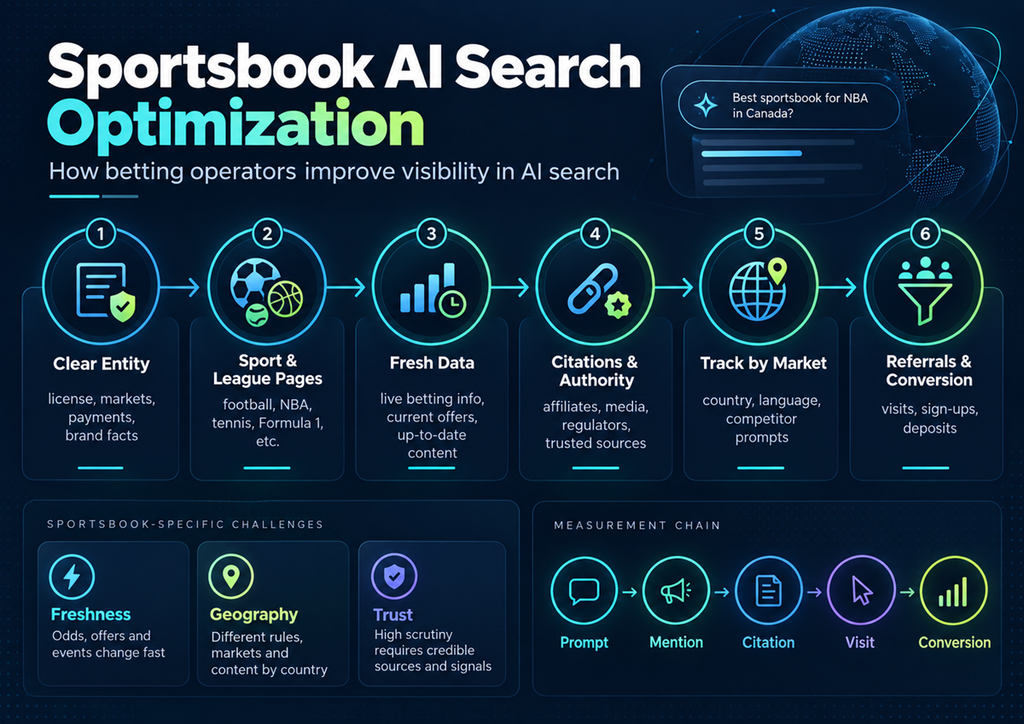
What Does AI Search Visibility Mean for a Sportsbook?
A sportsbook can appear in AI-generated answers in several different ways, and those should be measured separately.
- Direct brand visibility: the sportsbook is recommended or named in the answer.
- Citation visibility: the sportsbook website is cited as a supporting source.
- Third-party visibility: affiliates, media, regulators or review sites mention the sportsbook and are cited by the AI system.
- Product visibility: the operator is associated with a specific sport, betting market, feature, payment method or geographic market.
- Referral visibility: AI-generated answers produce measurable visits to the sportsbook website.
Those outcomes are related but not identical. A sportsbook may be recommended without receiving a citation. Another may rarely be named directly but have its help centre, rules or market pages cited repeatedly. A third may receive no direct AI referral traffic while still benefiting from stronger brand presence in answers.
Why Sportsbook AI Search Is Harder Than Static Product Search
Sports betting combines evergreen information with extremely volatile information.
| Information type | Examples | AI Search challenge |
|---|---|---|
| Evergreen operator facts | Ownership, licensing, payment methods, app availability | Needs consistency across the website and third-party sources |
| Market-specific facts | Countries served, currencies, payment options | Answers can differ materially by location |
| Product facts | Sports covered, live betting, cash-out, bet builder | Needs clear feature pages and unambiguous terminology |
| Event data | Fixtures, start times, teams, leagues | Changes constantly and becomes stale quickly |
| Odds and markets | Prices, spreads, totals, player props | Highly time-sensitive and unsuitable for stale static copy |
| Promotions | Welcome offers, boosts, free bets | Terms can change or expire and vary by jurisdiction |
This is why a sportsbook should not treat “AI optimization” as a content rewrite project alone. The underlying information architecture, freshness signals, crawlability, local market structure and external corroboration matter just as much.
1. Build a Clear Sportsbook Entity
Before trying to rank for “best sportsbook” prompts, make sure an AI system can answer basic questions about the operator without confusion.
Important entity facts can include the legal or trading name, parent company, licensing information, markets served, official domains, mobile apps, support channels and major product categories.
The same facts should not contradict each other across the homepage, about page, terms, licence information, app listings, help centre and country-specific pages. When a sportsbook operates multiple brands or market-specific domains, the relationship between them should be explicit.
For AI Search, ambiguity is expensive. If one source says an operator serves a market and another says it does not, the model may avoid making a recommendation altogether or rely more heavily on a third-party source.
2. Separate Evergreen Facts From Live Betting Data
A sportsbook website should distinguish information that remains stable for months from information that can change every minute.
Evergreen pages are good places to explain:
- which sports and leagues are covered;
- whether live betting is available;
- how cash-out works;
- which bet types are supported;
- deposit and withdrawal methods;
- app and mobile-web options;
- identity verification and account rules;
- responsible-gambling tools and limits.
Live odds, current markets and event-specific prices should come from systems designed for real-time data rather than being hard-coded into evergreen editorial copy. A page that still describes yesterday’s price as if it were current creates exactly the kind of factual inconsistency that weakens trust.
3. Create Strong Sport, League and Betting-Market Pages
Sportsbook users rarely ask only “Which betting site is best?” They ask much more specific questions: best sportsbook for football, best site for NBA betting, where to bet on Formula 1, which operator has player props, or which bookmaker supports live tennis betting.
That creates an opportunity for well-structured product pages around real betting categories. A strong page should explain what the sportsbook actually offers rather than repeating generic sport descriptions.
Useful details can include market depth, live coverage, bet-builder availability, statistics or visualizations, settlement rules, maximum-market availability where appropriate, app functionality and differences between pre-match and in-play betting.
The goal is to create a page that could genuinely answer a user question and provide evidence an AI system can retrieve — not a thin doorway page for every sport or league name.
4. Treat Geography as a Core AI Search Variable
Sportsbook availability is highly local. Licensing, accepted players, payment methods, currencies, promotions, tax treatment and product features may differ between jurisdictions.
For an international operator, a global “Sports Betting” page is rarely enough. Important markets should have clear local information explaining what is actually available there.
Local pages should avoid boilerplate where the only change is the country name. They should answer genuine market-specific questions such as:
- Is this sportsbook available to players in the country?
- Which licence or regulatory basis applies?
- Which deposit and withdrawal methods are supported?
- What currency is used?
- Which promotions are actually available there?
- Are any sports or betting products restricted?
This same principle should apply to AI visibility monitoring. A prompt such as “best sportsbook” should be tracked separately by priority country and language rather than interpreted as one global result.
5. Make Sportsbook Facts Easy to Retrieve and Verify
AI systems often need to retrieve a specific fact rather than summarize an entire page. Sportsbook content should therefore make important information easy to locate without turning the website into a collection of artificial “AI chunks.”
Clear headings, concise explanatory paragraphs, comparison tables, current terms, descriptive labels and internally consistent product pages help both users and retrieval systems understand the site.
Google’s current guidance for generative AI Search is especially relevant here: foundational SEO still applies, and Google explicitly says there is no requirement to create special AI text files, special schema or artificially “chunked” content to appear in its generative AI features.
Google’s guide to optimizing for generative AI features
6. Keep Event and Offer Content Fresh
Freshness is more important for sportsbooks than for many other iGaming businesses because the underlying product changes continuously.
Common failure points include expired offers, old league schedules, out-of-date app screenshots, discontinued payment methods, obsolete bonus terms and event pages that continue to look “live” after settlement.
Operators should define update rules for high-volatility content. That can include automated expiry, clear timestamps, archived status for completed events, canonical handling for recurring competitions and structured internal processes for promotional changes.
For editorial guides, visible review dates are useful only when the content is genuinely reviewed. Automatically changing “last updated” dates without substantive checks creates a freshness signal that users cannot trust.
7. Publish Information AI Systems Cannot Easily Reconstruct Elsewhere
Generic sportsbook copy is highly replaceable. “We offer great odds on football, tennis and basketball” adds little unique information.
More defensible content can come from original data and operator expertise, for example:
- proprietary market-depth statistics;
- betting trend data published in aggregate;
- sport-specific product usage insights;
- original surveys;
- transparent explanations of settlement rules;
- engineering or product insights about live betting;
- first-party research on payment or customer-service performance.
This is consistent with Google’s current recommendation to focus on unique, useful, non-commodity content rather than mass-producing pages that simply restate material already available across the web.
8. Strengthen Third-Party Authority
A sportsbook cannot control every source an AI system may use. Affiliates, regulators, sports media, industry publications, app stores and community discussions can all shape how a brand is represented.
That makes off-site consistency and authority part of AI Search strategy. Operators should know which external domains are repeatedly cited around their brand and their competitors, then distinguish between three different problems:
- Missing coverage: authoritative sources simply do not mention the sportsbook.
- Outdated coverage: third-party pages contain facts that are no longer correct.
- Weak comparative coverage: competitors receive more detailed or more credible reviews.
The response should be legitimate PR, better partner information, original research, stronger product evidence and accurate third-party updates — not manufactured mentions. Our AI Search & GEO agencies for iGaming comparison covers providers that may help with this layer.
9. Make the Sportsbook Crawlable by Search and AI Systems
Strong content cannot be cited if systems cannot reliably access it.
Sportsbooks should review robots directives, CDN or firewall rules, JavaScript rendering, canonical tags, country redirects, login walls and any system that could prevent public product information from being crawled.
For ChatGPT Search specifically, OpenAI says public websites can appear in search and recommends allowing OAI-SearchBot if publishers want content to be discoverable, surfaced and cited. OpenAI also states that ChatGPT referral URLs include utm_source=chatgpt.com, which can help with referral measurement. Our ChatGPT Visibility for iGaming guide covers the platform in depth.
OpenAI publisher and developer guidance
Blocking GPTBot for training and allowing OAI-SearchBot for search are separate choices. Operators should make crawler decisions intentionally rather than assuming every OpenAI bot serves the same purpose.
10. Use Structured Data for Search, Not as an AI Shortcut
Structured data still has value when it accurately describes page content and supports ordinary search features. But there is no special “sportsbook AI schema” that makes a bookmaker more likely to be recommended by generative systems.
Use schema where it is appropriate and valid for the page type, keep it consistent with visible content, and avoid marking up facts that users cannot see. Do not add unsupported entity or review markup simply because an AI-optimization checklist recommends it.
11. Build a Sportsbook Prompt Set
AI Search visibility cannot be managed from anecdotal screenshots. A sportsbook needs a repeatable prompt set covering both brand and discovery intent.
| Prompt group | Example | What it measures |
|---|---|---|
| Brand trust | Is Sportsbook X safe and licensed? | Entity accuracy and reputation |
| Market discovery | Best sportsbooks in Ontario | Local recommendation visibility |
| Sport | Best sportsbook for football betting | Product-category relevance |
| League | Best sportsbook for NBA betting | League-specific association |
| Feature | Which sportsbooks offer cash out? | Feature visibility |
| Bet type | Best sportsbook for player props | Market-depth visibility |
| Payments | Sportsbooks that support PayPal withdrawals | Payment-method relevance |
| Comparison | Sportsbook X vs Sportsbook Y | Competitive positioning |
| Publisher/source | Which sites have reliable sportsbook reviews? | Third-party influence and citation opportunity |
Run important prompts consistently across the same engines, locations and languages. Changing the test every week makes trend analysis unreliable.
12. Measure Mentions, Citations and Business Outcomes Separately
A sportsbook AI Search dashboard should separate at least three layers:
Visibility → Sources → Commercial outcomes
- Visibility: mentions, recommendation frequency, share of voice and sentiment.
- Sources: cited domains, cited pages and third-party sources influencing answers.
- Outcomes: AI referral sessions, registrations, deposits or other business metrics where attribution is possible.
Our AI Visibility Tracking for iGaming guide explains the broader framework. For visits and conversion attribution specifically, use our AI Referral Traffic for iGaming guide.
Which AI Visibility Tools Are Relevant to Sportsbooks?
Sportsbook operators can use the same core monitoring platforms as casinos and affiliates, but the evaluation criteria should be different.
We would prioritize:
- country and language controls;
- large enough prompt capacity to cover sports, leagues and features;
- citation and source-level reporting;
- competitor monitoring;
- daily or frequent tracking;
- exports or API access for larger teams;
- analytics integration where referral attribution matters.
Platforms we currently monitor include Omnia, Peec AI, Profound, OtterlyAI, SE Visible, Semrush AI Visibility, Ahrefs Brand Radar and Writesonic. See our Best AI Visibility & GEO Tools for iGaming comparison for the broader shortlist.
A 90-Day Sportsbook AI Search Plan
A sportsbook does not need to rebuild its entire SEO program around AI Search. A practical first 90 days can focus on measurement, factual clarity and high-value gaps.
| Period | Priority | Actions |
|---|---|---|
| Days 1–30 | Baseline | Build the prompt set, identify competitors, audit crawler access, map priority markets and record current mentions/citations |
| Days 31–60 | Fix facts and content gaps | Correct entity inconsistencies, improve country pages, strengthen sport/league/feature pages and remove stale offers |
| Days 61–90 | Authority and measurement | Address citation gaps, publish original data where justified, improve third-party information and compare visibility/referral changes |
The aim after 90 days is not to claim that the sportsbook “ranks #1 in ChatGPT.” The aim is to have a reliable baseline, cleaner information, stronger source coverage and a repeatable way to see whether visibility is improving.
Common Sportsbook AI Search Mistakes
- Treating live odds as evergreen content. Time-sensitive data needs time-sensitive systems.
- Creating hundreds of thin sport or country pages. Coverage should reflect genuine product differences and user needs.
- Tracking only branded prompts. Discovery prompts reveal competitive visibility.
- Ignoring local availability. Sportsbook recommendations can be jurisdiction-specific.
- Confusing mentions with citations. A recommended operator and a cited domain can be different entities.
- Using fake freshness. Updating a date without reviewing the content does not make the information current.
- Chasing llms.txt or special AI schema as shortcuts. Google explicitly says these are not required for its generative AI Search features.
- Buying mentions before diagnosing the source problem. Authority work should follow evidence.
FAQ
Is sportsbook GEO different from sportsbook SEO?
There is significant overlap. Technical accessibility, useful content, authority, internal linking and clear site structure still matter. GEO or AI Search work adds a stronger focus on prompt-level visibility, citations, source influence and how the sportsbook is represented in generated answers.
Does a sportsbook need llms.txt?
Not for Google Search. Google’s current guidance explicitly says it does not use llms.txt as a special signal for generative AI Search. A sportsbook can maintain such a file for other systems if there is a clear reason, but it should not be treated as an AI-ranking shortcut.
How should sportsbooks track ChatGPT visibility?
Use a stable prompt set segmented by country, sport, league, product feature and brand intent. Measure mentions and citations separately, compare competitors and connect identifiable ChatGPT referrals with analytics and conversion data where possible. Our AI Citation Tracking for iGaming guide explains the source-analysis layer in detail.
Can AI systems reliably show live sportsbook odds?
Sportsbook odds are highly time-sensitive, so any generated answer should be treated cautiously unless it is clearly grounded in a current source. Operators should make live data accessible through appropriate real-time product systems and avoid presenting stale static odds as current information.
What content is most useful for sportsbook AI visibility?
Start with accurate operator facts, strong country pages, clear sport and league coverage, betting-feature explanations, payment information and original data or expertise that competitors cannot easily reproduce. The best priorities depend on which prompts and sources your baseline tracking identifies.
Final Takeaway
Sportsbook AI Search is not a separate marketing channel that replaces SEO. It is a new discovery and answer layer built on many of the same foundations, with additional challenges around citations, geography, entity clarity and rapidly changing sports data.
The strongest sportsbook strategy is therefore straightforward: make the brand easy to understand, make product information easy to verify, keep dynamic facts current, publish genuinely useful material, build credible third-party authority and measure what major AI systems actually say.
For the next step, use our AI Visibility Tracking for iGaming guide to build the measurement layer, or compare platforms in our AI Visibility Tools for iGaming guide.