Last fact-check:
AI visibility is becoming measurable, but there is still no single universal “Search Console for AI.” An iGaming brand can be mentioned in ChatGPT, cited in Perplexity, surfaced in Google AI Mode, ignored in Gemini and still receive almost no measurable referral traffic. See our Perplexity Visibility for iGaming guide for the platform-specific citation and crawler framework.
That means casino operators, sportsbooks, affiliates and B2B suppliers need to track several layers separately: prompts, mentions, citations, share of voice, sentiment, source domains, referral traffic and conversions. Sportsbook operators can pair this framework with our AI Search Optimization for Sportsbooks guide.
This guide explains the measurement framework we recommend for iGaming and how tools such as Omnia, Peec AI, OtterlyAI, Profound, Semrush, SE Visible and Ahrefs Brand Radar fit into it.
For software comparisons, see our Best AI Visibility & GEO Tools for iGaming guide. Affiliate publishers can also use our dedicated Best AI Tools for iGaming Affiliates comparison.
What Is AI Visibility Tracking?
AI visibility tracking is the process of repeatedly testing a defined set of prompts across AI-powered search and answer engines, then measuring how often a brand, website or source appears.
For iGaming, that can include questions such as:
- What are the best online casinos in Canada?
- Which casino has the fastest withdrawals in Finland?
- Is Casino X licensed and safe?
- Which sportsbooks are best for football betting in Nigeria?
- Which websites should I trust for casino reviews?
- Which casinos support Trustly withdrawals?
The purpose is not simply to count mentions. A useful tracking system should show where the brand appears, why it appears, which sources support the answer, how competitors compare and whether visibility produces business outcomes.
The AI Visibility Measurement Funnel
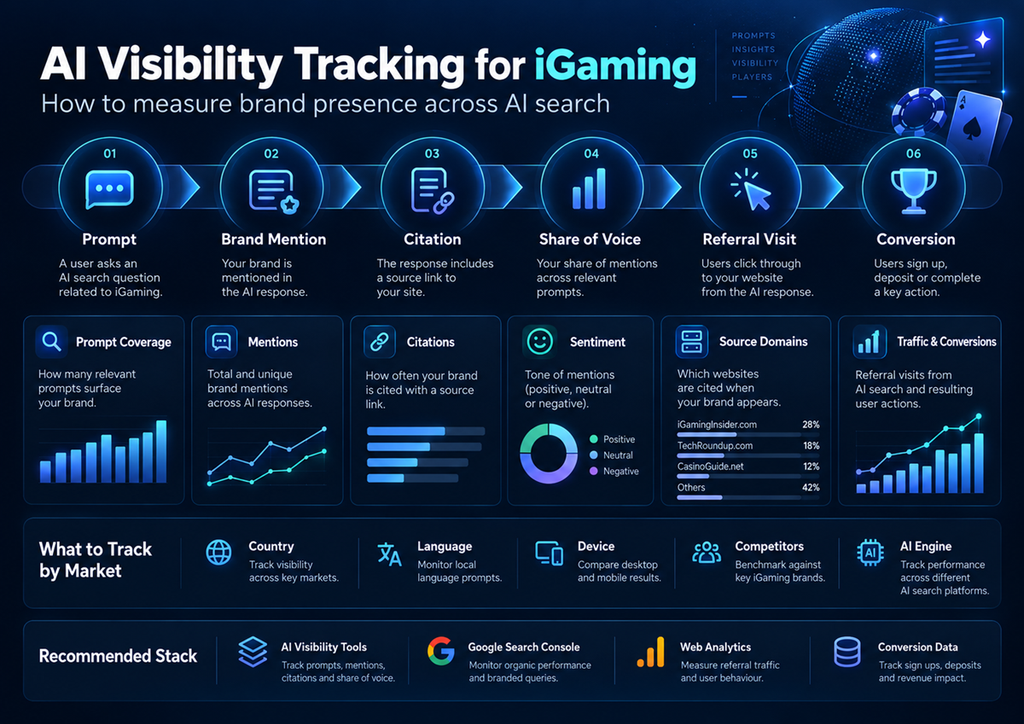
We recommend treating AI Search as a funnel:
Prompt → Brand Mention → Citation → Share of Voice → Referral Visit → Conversion
Each stage answers a different question.
| Metric | What it tells you | Why it matters in iGaming |
|---|---|---|
| Prompt coverage | Which commercial and informational questions you monitor | Casino and sportsbook intent changes by market, payment method and product |
| Brand mention rate | How often your brand appears | Measures direct recommendation or awareness visibility |
| Citation rate | How often your domain or another source is cited | Shows whether your content is being used as evidence |
| Share of voice | Your visibility relative to competitors | Useful when several operators or affiliates compete in the same answer set |
| Sentiment / positioning | How the brand is described | Important for trust, safety, licensing and reputation prompts |
| Source share | Which domains AI systems rely on | Reveals affiliates, media, forums and competitors influencing answers |
| AI referral traffic | Visits arriving from identifiable AI sources | Connects visibility with real website traffic |
| Conversions | Registrations, FTDs, leads or revenue | Shows whether AI visibility has commercial value |
1. Start With a Controlled Prompt Set
The quality of the prompt set determines the quality of the measurement.
Tracking only branded prompts such as “Casino X review” is not enough. Those questions can tell you whether the brand is understood correctly, but they do not show whether the brand competes in discovery.
A balanced iGaming prompt set should include several intent groups:
- Brand: Is Casino X safe? Who owns Casino X?
- Discovery: Best online casinos in [country].
- Payments: Best casino with [payment method].
- Product: Best live casino, crypto casino or football sportsbook.
- Comparison: Casino X vs Casino Y.
- Trust: Safest licensed casinos in [market].
- Publisher: Best websites for casino reviews or betting comparisons.
Keep the core prompt wording stable when measuring change over time. If every reporting cycle uses different prompts, a change in visibility may reflect the test rather than the brand.
2. Track by Country and Language
This is especially important in gambling. A casino may be relevant in one country and unavailable in another. Licensing, payment methods, currencies, brands and affiliate results may all differ between markets.
For an international operator or affiliate, “best online casino” should not be treated as one global prompt. It may need separate tracking for the UK, Canada, Finland, Germany, Nigeria, the Gulf or other priority markets, plus separate language versions where appropriate.
When evaluating a platform, check whether country and language controls are included in the plan or increase the cost significantly. This is one reason we give geographic controls substantial weight in our iGaming AI visibility tool comparisons.
3. Separate Mentions From Citations
A brand mention and a citation are not the same thing.
An AI answer may recommend Casino X but cite an affiliate review, regulator, news article or operator help page. From a measurement perspective, that creates at least two separate opportunities:
- Brand visibility: Are we named in the answer?
- Source visibility: Is our website used as supporting evidence?
Affiliates may care particularly about source visibility because an operator can receive the recommendation while the affiliate earns the citation and potentially the click. Operators, meanwhile, should monitor which third-party publishers influence how their brand is described.
We cover this in more depth in our dedicated AI Citation Tracking for iGaming guide.
4. Measure Share of Voice, Not Just Raw Mentions
Twenty mentions may sound impressive until you discover a competitor appeared 80 times across the same test set.
Share of voice helps normalize the result. Different platforms calculate it differently, so the exact percentage should not be compared blindly between tools, but the metric is useful for tracking relative movement inside one consistent system.
For example, an operator might monitor whether its visibility improves relative to five competitors across 100 payment, trust and discovery prompts. An affiliate might compare how frequently its domain is cited against three competing publishers.
5. Track Sentiment and Factual Accuracy
Visibility is not automatically positive.
An online casino could appear frequently while being described with an outdated licence, incorrect withdrawal policy or negative reputation summary. An affiliate might be cited while its brand is characterized as outdated or untrustworthy.
For iGaming, we would manually review high-value prompts for facts such as:
- licensing authority;
- accepted countries;
- payment methods;
- withdrawal conditions;
- operator ownership;
- bonus restrictions;
- support availability.
This is particularly relevant for operators. Our AI Visibility for Online Casinos guide explains why factual consistency is one of the strongest foundations for casino AI visibility.
6. Identify the Sources AI Systems Are Using
Source analysis is often more actionable than the visibility score itself.
If a competitor is repeatedly recommended, ask which domains support those recommendations. You may discover that AI answers rely on:
- affiliate reviews;
- operator help centres;
- industry news publications;
- regulatory sources;
- Reddit or forum discussions;
- comparison pages;
- corporate announcements and press coverage.
That changes the question from “How do we improve our AI score?” to “Which information sources are missing from our authority footprint?”
7. Connect AI Visibility With Referral Traffic
Prompt trackers estimate or observe visibility. Analytics measures real visitors.
OpenAI says ChatGPT referral URLs include utm_source=chatgpt.com, allowing publishers to identify inbound ChatGPT search traffic in analytics platforms such as Google Analytics. OpenAI also states that sites that want eligibility for ChatGPT Search discovery should allow OAI-SearchBot. See our ChatGPT Visibility for iGaming guide for the full platform-specific setup.
For affiliates, the useful reporting chain is:
AI referral → landing page → operator click → registration → FTD → revenue
For an operator:
AI referral → landing page → registration → deposit → player value
Our AI Referral Traffic for iGaming guide explains this layer in detail, including GA4 source tracking, landing pages, conversions and attribution limitations.
8. Use Google Search Console for Google’s AI Features
Google Search Console has become more useful for this measurement problem. Google now provides a dedicated Generative AI performance report for Search, covering performance in generative AI features such as AI Overviews and AI Mode.
The report can show generative-AI impressions over time, pages receiving those impressions, and dimensions such as country and device. Google says these insights rolled out worldwide by August 31, 2026, although a property may still lack visible data if it has not received enough generative-AI impressions.
Google Search Console generative AI performance documentation
This does not replace a multi-engine AI visibility tracker. It gives you Google’s first-party view of its own AI search surfaces, while specialist tools can monitor controlled prompts across multiple engines.
Which Tools Can Track AI Visibility for iGaming?
The main platforms we currently monitor include Omnia, Peec AI, OtterlyAI, Profound, Semrush AI Visibility, SE Visible, Ahrefs Brand Radar and Writesonic. Omnia and OtterlyAI are now both hands-on tested by iGaming AI Search; see our Omnia review and Otterly AI review.
| Tool | Useful for | iGaming consideration |
|---|---|---|
| Omnia | Prompt monitoring, citations, share of voice, sentiment, GEO actions | Strong multi-market structure; we have tested it hands-on |
| Peec AI | Structured visibility monitoring and AI referral analytics | Useful for teams connecting visibility to GA4 |
| OtterlyAI | Lower-cost daily monitoring | Good starting point for smaller affiliates |
| SE Visible | High prompt allowances | Useful where country/product prompt sets become large |
| Semrush | AI visibility inside an established SEO stack | Natural fit for existing Semrush users |
| Ahrefs Brand Radar | Large-scale source and market research | Useful for authority and citation research |
| Profound | Enterprise analysis and reporting | More relevant to large operators or affiliate groups |
| Writesonic | Visibility plus content/SEO workflows | Broader execution platform rather than pure monitoring |
Our full iGaming AI visibility tools comparison looks at pricing and feature differences in more detail.
From Tracking to Action: What to Do With Citation Gaps
Tracking only becomes useful when it changes what you do.
If your visibility analysis shows that competitors are being cited from sources you do not appear in, possible responses include improving first-party pages, publishing original data, correcting inconsistent brand information, strengthening affiliate relationships, digital PR or legitimate news distribution.
BrandPush is one example of a distribution service that can support the off-site authority layer, but it is not an AI visibility tracker or a GEO agency. It distributes business news stories across publisher networks.
There is an important iGaming limitation: BrandPush currently accepts betting, casinos and sports-picks topics only on its Access package. The Access package is currently $195 as a one-time purchase and publishes to around 200 news sites. Gambling topics are not accepted on BrandPush’s Growth, Authority, Ultimate, MSN or Yahoo Finance options.
That also means iGaming brands should not rely on BrandPush’s higher-tier AI-citation claims: those higher packages are not available for casino/betting content. We would treat Access distribution as a potential PR and authority input, not as a guarantee of ChatGPT, Gemini or Perplexity citations.
For broader service-provider comparisons, see our Best AI Search & GEO Agencies for iGaming page.
A Practical Monthly AI Visibility Report
A useful monthly report does not need dozens of vanity metrics. We would include:
- number of prompts monitored;
- brand mention rate;
- citation rate;
- share of voice versus named competitors;
- top cited domains;
- newly gained or lost citations;
- material sentiment or factual changes;
- AI referral sessions;
- AI-assisted conversions where measurable;
- three to five actions for the next reporting period.
Keep the same core prompt set and comparison group from month to month. Add new prompts when the business changes, but do not replace the whole benchmark every reporting cycle.
Common AI Visibility Tracking Mistakes
- Tracking only the brand name. Discovery prompts usually reveal more competitive information.
- Ignoring geography. iGaming answers can be completely different between countries.
- Treating mentions as traffic. A mention does not necessarily create a click.
- Ignoring citations. The supporting source may matter as much as the recommended brand.
- Changing the prompt set constantly. That destroys the benchmark.
- Comparing scores between different tools as if they were identical. Methodologies vary.
- Buying PR before identifying the source gap. Distribution should follow evidence, not replace it.
- Reporting visibility without conversions. Commercial outcomes should be measured whenever possible.
AI Visibility Tracking for Casino Operators
Casino operators should prioritize brand accuracy, market availability, licensing, payments and reputation alongside discovery visibility. Track both your own brand and the competitors that appear for commercial prompts.
See our AI Visibility for Online Casinos guide for the operator-specific framework.
AI Visibility Tracking for iGaming Affiliates
Affiliates should track two different assets: the operators being recommended and the affiliate domains being cited. An affiliate can lose recommendation traffic even when its own brand is rarely mentioned if competing publishers become more frequently cited sources.
See our AI Search Optimization for iGaming Affiliates guide and affiliate AI visibility tools comparison.
FAQ
What is the best metric for AI visibility?
There is no single best metric. Brand mention rate, citation rate, share of voice, source domains and referral traffic answer different questions. For commercial reporting, use a small group of metrics rather than one visibility score.
Can Google Search Console track AI visibility?
For Google’s own generative AI features, yes. Search Console’s Generative AI performance report can show impressions, pages, country and device data where sufficient data is available. It does not replace multi-engine prompt monitoring for ChatGPT, Perplexity, Gemini and other platforms. Our Gemini Visibility for iGaming guide explains how Gemini Apps differ from Google AI Overviews and AI Mode.
Can I see clicks from ChatGPT?
Yes, identifiable referrals can be measured in web analytics. OpenAI says ChatGPT referral URLs include utm_source=chatgpt.com. This measures actual visits, while AI visibility tools measure mentions, citations and prompt-level visibility.
How often should iGaming brands track AI visibility?
Daily tracking is useful for active monitoring, but strategic reporting can usually be monthly. The important part is using a stable prompt set and consistent methodology so changes can be interpreted properly.
Does press release distribution improve AI visibility?
It can contribute to the external information environment around a brand, but distribution does not guarantee AI mentions or citations. We would use it only after identifying a genuine authority or source gap and only for legitimate newsworthy information.
Final Takeaway
AI visibility tracking is most useful when it connects three layers:
Visibility → Sources → Business Outcomes
For iGaming, the winning measurement system is unlikely to be one dashboard. It will usually combine a prompt-monitoring platform, source and citation analysis, Google Search Console, web analytics and conversion data.
Start with a stable set of commercially meaningful prompts, segment them by market, measure mentions and citations separately, and then use the data to decide what content, authority or technical work actually deserves investment.