AI search is creating a new measurement problem for casino operators, sportsbooks and iGaming affiliates.
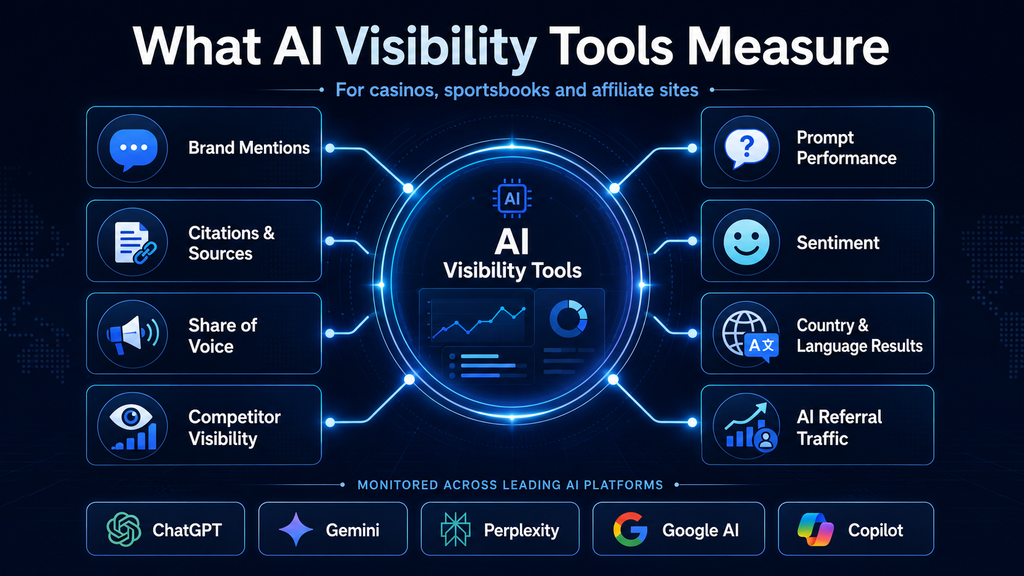
Traditional SEO platforms can tell you where a website ranks in Google. They do not necessarily tell you whether ChatGPT recommends your casino, which affiliate domains Perplexity cites, how often Gemini mentions a competing sportsbook or whether an operator’s visibility changes between markets.
A new generation of AI visibility tools, GEO software and LLM tracking platforms is designed to answer those questions.
At iGaming AI Search, we compare these platforms specifically from an iGaming perspective. That means looking beyond generic features such as “ChatGPT tracking” and examining issues that matter to gambling businesses: geographic segmentation, multilingual prompts, large competitor sets, casino and sportsbook queries, citations, brand sentiment, reporting and the cost of monitoring visibility at scale.
Our current shortlist includes Peec AI, Profound, Writesonic, Otterly AI, Semrush AI Visibility, SE Visible and Ahrefs Brand Radar.
Important: This page distinguishes between information verified from current vendor documentation and conclusions from our own editorial analysis. We will add hands-on testing results and ratings only after completing our standardized iGaming testing process.
Last fact-check:
Best AI Visibility Tools for iGaming: Quick Comparison
| Tool | Best suited to | Entry pricing | Prompt/AI coverage at entry level | Main reason to consider it |
|---|---|---|---|---|
| Peec AI | Multi-market brands and SEO teams | Varies by plan | Starter: 50 prompts, 3 selected models | Flexible AI-search tracking with country/language support |
| Profound | Larger operators and enterprise teams | $99/month annually | Starter: 50 prompts, ChatGPT | Deep AI visibility, citation, prompt and enterprise analytics |
| Writesonic | SEO/content teams wanting monitoring + optimization workflows | $79/month annually | Starter: 50 prompts; ChatGPT, Gemini, Google AI Overviews | Combines AI visibility tracking with SEO, content and optimization workflows |
| Otterly AI | Affiliates and smaller teams | $29/month | 15 prompts; ChatGPT, Google AI Overviews, Perplexity, Copilot | Low-cost entry into daily AI tracking |
| Semrush AI Visibility | Existing SEO/marketing teams | $99/month per domain annually | 25 custom prompts; ChatGPT, Google AI, Gemini, Perplexity | AI visibility integrated with a broader marketing ecosystem |
| SE Visible | Agencies and multi-project teams | $99/month | 200 prompts, 3 projects, 5 AI/search experiences | Strong prompt allowance and multi-project structure |
| Ahrefs Brand Radar | Market research and large-scale discovery | From $199/month for one AI index | Large search-backed prompt database + optional custom tracking | Broad competitive and citation discovery |
| Omnia | Teams wanting AI visibility monitoring + actionable GEO workflows | €79/month monthly or €63/month with annual billing | 25 prompts; 4 engines by default, expandable to 7 | Combines tracking, citation analysis and an AI agent that can help execute optimization work |
Writesonic’s current Starter plan costs $79/month when billed annually and includes 50 tracked prompts and 50 answers tracked daily across ChatGPT, Gemini and Google AI Overviews. Basic increases this to 100 prompts and 300 daily answers, while Growth provides 200 prompts and 600 daily answers. Enterprise expands tracking to 10 platforms, including ChatGPT, Perplexity, Claude, Gemini, Grok, DeepSeek, Microsoft Copilot, Meta AI and Google’s AI experiences.
Peec currently offers 50 prompts on Starter, 150 on Pro and 350 on Advanced, with Advanced adding multi-country functionality; its enterprise tier can cover up to 11 LLM models. Profound’s Starter plan is currently $99/month billed yearly with 50 ChatGPT prompts, while Growth is $399/month with three answer engines and 100 prompts. Otterly starts at $29/month for 15 prompts and four core AI/search engines.
Semrush’s AI Visibility Base plan starts at $99/month per domain when billed annually and includes 25 custom prompts plus ChatGPT, Google AI, Gemini and Perplexity coverage. SE Visible currently starts at $99/month with 200 prompts and three projects. Ahrefs Brand Radar provides access to a database of more than 405 million search-backed prompts across seven AI platforms, with standalone AI indexes starting at $199/month.
Prices and plan limits can change. We therefore check current vendor pricing before publishing major updates to this comparison.
What Makes an AI Visibility Tool Good for iGaming?
There is no single “best GEO tool” for every gambling business.
A casino operator active in 20 countries has very different requirements from an affiliate monitoring one English-language website. An iGaming agency managing 30 clients needs different reporting and account controls from an in-house sportsbook SEO team. See our AI Search Optimization for Sportsbooks guide for the operator-specific strategy.
For iGaming, we consider the following criteria particularly important.
AI Engine Coverage
At minimum, serious monitoring should consider the platforms where users increasingly discover and compare brands.
Depending on the tool and subscription level, these can include:
- ChatGPT
- Gemini
- Perplexity
- Google AI Overviews
- Google AI Mode
- Microsoft Copilot
- Claude
- Grok
- DeepSeek
More platforms are not automatically better. A business should first identify which engines matter to its audience and then determine whether the tool measures those environments in a useful and repeatable way.
Geographic Tracking
This is more important in iGaming than in many other sectors.
An operator may accept customers in Canada but not the United Kingdom. A sportsbook may have a licence in one jurisdiction but operate under a different structure elsewhere. Bonuses, payment methods, legal availability and even brand recognition can differ significantly between countries.
An AI visibility score that combines everything into one global number can therefore hide important information.
We favour tools that make it possible to segment prompts or responses by market.
Peec, for example, states that supported countries and languages can be tracked without separate regional pricing, although the number of countries available per project depends on the subscription tier. Profound also provides regional filtering within Answer Engine Insights.
Multilingual Prompt Monitoring
International iGaming companies rarely operate exclusively in English.
Useful monitoring may need to cover prompts in:
German, Spanish, Portuguese, Arabic, Italian, French, Dutch, Finnish, Japanese and many other languages.
We therefore distinguish between a platform being technically capable of processing multilingual prompts and offering a genuinely useful country/language monitoring workflow.
This is an area we intend to investigate closely in our own tests.
Competitor Visibility
It is not enough to know:
“Our brand visibility score is 38.”
The useful question is:
“Why does Casino A appear for these prompts while Casino B does not?”
Good AI visibility software should allow teams to identify:
- competing brands appearing in the same answers;
- share of voice;
- recommendation frequency;
- prompt gaps;
- changing competitive positions;
- sources supporting competitor visibility.
That makes the information actionable.
Citation Tracking
Citations are particularly important for iGaming. See our AI Citation Tracking for iGaming guide for the full source-analysis methodology.
An AI platform may mention a casino but rely on a completely different website as its supporting source.
That source could be:
an affiliate comparison site, a regulator, Wikipedia, Reddit, an industry publication, an operator page or another third-party website.
Understanding those source patterns can provide useful information for SEO, content and digital PR teams.
Prompt Volume and Scalability
Prompt limits can become expensive surprisingly quickly.
Consider an operator that wants to monitor:
100 commercial questions
× 10 countries
× 3 AI platforms
That already creates a substantial monitoring requirement.
Add separate languages, casino categories, sportsbook products and competitors and the required dataset can grow rapidly.
We therefore look not only at the headline subscription price but also at:
prompt limits, execution frequency, model limits, locations, additional projects and overage costs.
Sentiment and Brand Accuracy
Being mentioned by ChatGPT is not automatically positive.
For example, an AI answer might associate an operator with outdated licence information, an old bonus, unsupported payment methods or a country the operator no longer accepts.
For regulated or reputation-sensitive businesses, tools that reveal what AI says, not simply whether a brand appears, may be substantially more useful.
Reporting and Agency Features
For agencies and larger iGaming companies, we also examine:
- multiple projects;
- multiple brands;
- unlimited or additional users;
- dashboards;
- exports;
- API access;
- client workspaces;
- white-label or shareable reports;
- custom prompt management.
These features may matter little to an independent affiliate but become essential at agency or enterprise scale.
Otterly AI
Best for: Affiliates and smaller iGaming teams starting AI monitoring
Otterly AI offers one of the lowest entry prices among the major dedicated AI visibility platforms in our initial comparison.
Its current Lite plan costs $29/month and provides 15 search prompts with daily monitoring across:
ChatGPT, Google AI Overviews, Perplexity and Microsoft Copilot.
The Standard plan costs $189/month and raises the allowance to 100 prompts, while Premium costs $489/month for 400 prompts.
Gemini, Google AI Mode and Claude are currently available through additional paid add-ons.
Standard and Premium also provide API and MCP access, and Otterly offers enterprise plans for larger requirements.
For an iGaming affiliate that wants to start by tracking perhaps 10–15 highly commercial prompts, Lite creates a relatively inexpensive way to experiment before committing hundreds of dollars per month.
Examples might include:
best crypto casino
best casino for fast withdrawals
safest online casino
best football betting site
best casino accepting Bitcoin
Potential iGaming strengths:
- low entry price;
- daily tracking;
- unlimited team members;
- four core search/AI environments;
- scalable prompt packages;
- API on Standard+.
Potential drawback:
Important platforms such as Gemini and Claude are add-ons rather than being included in the base plans.
Peec AI
Best for: Multi-market AI visibility monitoring
Peec AI is a specialist AI search analytics platform built around prompt tracking, brand visibility and competitor analysis.
Its current Starter plan includes 50 prompts, three selected models, daily tracking, unlimited users and one project. Pro increases that to 150 prompts and two projects, while Advanced provides 350 prompts, five projects, multi-country functionality and Looker Studio integration.
Available model options currently include ChatGPT, Google AI Mode, AI Overviews, Microsoft Copilot, Perplexity and Gemini, with a wider model set available at enterprise level.
One feature that immediately interests us for iGaming is Peec’s approach to countries and languages. The company states that supported regions and languages do not create a separate pricing charge, although plan-level country limits still apply.
That could make the platform particularly relevant to international casino operators and multilingual affiliates.
Potential iGaming strengths:
- country/language tracking;
- daily prompt monitoring;
- competitor benchmarking;
- citation analysis;
- multiple projects on higher plans;
- agency options;
- enterprise API availability.
What we want to test:
How accurately does Peec differentiate the same gambling prompt across countries? How practical is it to maintain large multilingual prompt sets? And how useful are its citation and competitor reports for casino-affiliate analysis?
Profound
Best for: Enterprise iGaming teams needing deeper AI-search analytics
Profound is one of the most comprehensive platforms in this category.
Its Answer Engine Insights product tracks visibility, share of voice, citations, sentiment and competitor performance, while Profound also offers prompt-demand data, AI crawler analytics and content/automation capabilities.
Pricing currently starts at $99/month billed annually for Starter, which monitors 50 prompts in ChatGPT. Growth costs $399/month billed annually, increases coverage to three answer engines and 100 prompts, and adds more of Profound’s broader workflow capabilities. Enterprise plans expand coverage considerably further.
Profound says it captures responses from consumer-facing AI experiences rather than relying only on model APIs. It currently supports a broad range of answer engines at higher tiers, including ChatGPT, Perplexity, Claude, Gemini, Google AI experiences, Copilot, Grok and DeepSeek.
Its citation analysis is particularly interesting for iGaming because it identifies which publishers and sources influence AI answers and can surface citation opportunities.
Potential iGaming strengths:
- strong enterprise analytics;
- daily prompt tracking;
- citations and share of voice;
- regional filtering;
- sentiment analysis;
- prompt-demand research;
- AI crawler analytics;
- reporting dashboards;
- enterprise security and access controls.
Potential drawback:
The lower-priced Starter tier covers only ChatGPT, meaning meaningful multi-engine monitoring requires a higher plan.
For larger casino groups, suppliers or sophisticated affiliate businesses, Profound may nevertheless justify closer investigation because it goes beyond basic prompt monitoring.
Writesonic
Best for: AI visibility plus SEO and content workflows
Writesonic has developed from an AI writing platform into a broader AI Search Visibility and GEO platform.
Its current AI Visibility Tracker monitors how brands appear in AI-generated answers and provides data on visibility, citations, sentiment, competitors and share of voice. Users can also filter results by market, language and intent.
Unlike platforms focused almost entirely on monitoring, Writesonic combines AI visibility data with a broader SEO and content ecosystem. This makes it particularly interesting for teams that want to move from:
“Where are we missing from AI search?”
to:
“What should we change to improve that visibility?”
The current Starter plan costs $79/month when billed annually and includes:
- 50 prompts;
- 50 answers tracked daily;
- ChatGPT tracking;
- Gemini tracking;
- Google AI Overviews tracking;
- one market defined by language and country;
- one project;
- AI bot analytics;
- 15 AI articles per month;
- 10 site audits of up to 100 pages each.
Basic currently costs $199/month, while Growth costs $399/month. Prompt allowances increase to 100 and 200 respectively.
Writesonic’s Enterprise offering expands AI visibility monitoring to 10 AI platforms, including ChatGPT, Perplexity, Claude, Gemini, Grok, DeepSeek, Microsoft Copilot, Meta AI, Google AI Mode and Google AI Overviews.
One particularly interesting aspect for iGaming is its support for filtering AI-search data by market and language. International gambling brands frequently need to understand whether the same operator appears differently across countries and languages, making this something we intend to test carefully.
Writesonic also analyzes citation sources. This can help reveal which websites and pages are influencing AI answers about a category – potentially valuable information for iGaming SEO, affiliate and digital PR teams.
Potential iGaming strengths:
- daily AI visibility monitoring;
- market and language segmentation;
- citation analysis;
- sentiment analysis;
- competitor comparison;
- AI-search and conventional SEO workflows in one platform;
- content and technical optimization features;
- agency-specific plans;
- broader AI-engine coverage at enterprise level.
Potential drawbacks:
The Starter, Basic and Growth plans currently track only ChatGPT, Gemini and Google AI Overviews. Businesses wanting Perplexity, Claude and the full 10-platform dataset need the Enterprise tier.
The platform also includes substantial content and SEO functionality, so companies looking only for a simple AI rank tracker may find a more focused product better suited to their needs.
Omnia
Best for: AI visibility monitoring with an action-oriented GEO assistant
Omnia is an AI visibility platform designed to do more than simply report whether a brand appears in ChatGPT.
The platform monitors brand visibility, competitors, citations, sentiment and prompts across major AI-search environments. It also includes Omnio, an AI-powered GEO assistant that analyzes visibility gaps and can help turn the data into concrete actions such as content improvements, new content, briefs and third-party outreach.
This makes Omnia particularly interesting for iGaming SEO and content teams that want to move beyond:
“Our visibility score went down.”
toward:
“Why did it go down, and what should we do next?”
Omnia currently tracks four AI/search environments by default:
- ChatGPT;
- Google AI Mode;
- Perplexity;
- Google AI Overviews.
Claude, Gemini and Microsoft Copilot can also be unlocked or made available depending on the plan and configuration, bringing potential coverage to seven engines. Prompts are monitored daily.
Omnia Pricing
The current Growth plan costs €79/month with monthly billing, or the equivalent of €63/month on annual billing.
Growth includes:
- up to 25 monitored prompts;
- daily monitoring;
- four AI engines by default;
- up to seven supported engines;
- sentiment analysis;
- 150 monthly Insight credits;
- unlimited brands;
- country and language support;
- Omnio GEO assistant;
- 14-day free trial.
The Pro plan currently costs €279/month, or €223/month with annual billing, and increases monitoring to 100 prompts and 600 monthly Insight credits.
Enterprise currently starts at €499/month, or €399/month with annual billing, and provides 200+ prompts, 1,500 Insight credits and dedicated support.
One useful aspect of Omnia’s pricing model is that additional prompt packs can be added without immediately moving to a more expensive plan. Insight credits can also be purchased separately, and unused credits currently roll over rather than expiring.
Country and Language Tracking
Geographic monitoring is particularly important for iGaming, and this is one of the features that makes Omnia worth investigating.
Omnia says it can simulate real-user behaviour from different locations and supports tracking across countries and languages. Its pricing information also lists unlimited brands, countries and languages across its plans.
For an international casino group or affiliate, this could make it possible to compare questions such as:
best online casinos in Finland
against:
best online casinos in Canada
and examine whether the same brands, competitors and citation sources appear.
This is something we would want to verify carefully in our own iGaming testing because country-specific AI results are particularly important in gambling.
Citation and Competitor Analysis
Omnia monitors not only whether a brand appears but also which sources AI systems cite.
Its visibility reports include:
- visibility score;
- share of voice;
- competitor performance;
- citation sources;
- prompt-level visibility;
- sentiment.
This can help identify situations where a competitor appears more frequently because particular external websites are repeatedly being cited.
For iGaming SEO and digital PR teams, that can potentially turn citation monitoring into a more actionable workflow.
Omnia’s MCP integration also allows users to query visibility data, analyze citations, compare competitors and manage prompts directly through compatible AI assistants such as ChatGPT or Claude.
Omnio: The GEO Agent
The feature that most clearly differentiates Omnia from a simple rank tracker is Omnio, its AI visibility agent.
According to Omnia, Omnio can examine where a brand is underperforming, prioritize opportunities and assist with work intended to improve visibility.
Its capabilities currently include:
- analyzing visibility gaps;
- identifying citation opportunities;
- creating or rewriting content;
- generating briefs;
- helping with third-party outreach;
- integrating with a CMS;
- measuring whether visibility changes after actions are implemented.
Importantly, Omnia describes these workflows as approval-based rather than autonomous publishing without oversight.
For an iGaming team, that could make Omnia particularly useful where the objective is not simply monitoring AI search, but establishing an ongoing GEO workflow.
Potential iGaming Strengths
- daily prompt tracking;
- country and language support;
- unlimited brands;
- ChatGPT, Perplexity and Google AI monitoring;
- additional AI engines available;
- citation analysis;
- competitor share-of-voice tracking;
- sentiment analysis;
- prompt discovery;
- actionable visibility insights;
- built-in GEO agent;
- content and outreach workflows;
- API/MCP-style integration possibilities;
- relatively accessible starting price.
Potential Drawbacks
The Growth plan monitors only 25 prompts, so an international casino operator covering multiple products, markets and languages could exceed the entry-level allowance quickly.
Four engines are included by default, while Claude, Gemini and Microsoft Copilot require additional availability or configuration rather than being part of the standard four-engine setup.
Omnia’s credit system also adds another variable to pricing. Prompt monitoring and optimization Insights use different units, so teams should estimate both requirements rather than comparing the subscription price alone.
Finally, we have not yet independently tested Omnia with casino, sportsbook or gambling-affiliate prompts. Its published Terms currently require lawful business use and do not state a general gambling prohibition, but we would still recommend confirming iGaming suitability directly with Omnia before an operator commits to a plan.
Why Omnia Could Be Interesting for iGaming
Omnia occupies an interesting position between a pure AI visibility tracker and a GEO execution platform.
A tool such as a basic prompt tracker may tell an affiliate:
Your website is cited in 8% of monitored answers.
Omnia is attempting to continue the workflow:
Which competing sites receive the missing citations?
Which pages influence those answers?
What content or external authority gap may explain the difference?
What should we work on next?
For iGaming companies with internal SEO, content and digital PR resources, that combination could potentially reduce the gap between measurement and execution.
We therefore consider Omnia one of the more interesting platforms to include in our future standardized iGaming testing.
Semrush AI Visibility Toolkit
Best for: iGaming SEO teams already using Semrush
Semrush has expanded beyond conventional keyword, backlink and technical SEO analysis with a dedicated AI Visibility Toolkit.
Its Base plan currently costs $99/month per domain when billed annually.
It includes:
- AI visibility reports;
- 25 custom prompts with daily tracking;
- one domain for Brand Performance;
- ChatGPT;
- Google AI;
- Gemini;
- Perplexity;
- competitor analysis;
- prompt research;
- AI-readiness auditing.
Semrush also measures AI brand sentiment and share of voice and can surface mentions, citations and competitor gaps.
The obvious attraction for iGaming SEO departments is consolidation.
A team already using Semrush for conventional SEO may prefer adding AI-search monitoring to its existing ecosystem rather than introducing an entirely separate vendor.
Potential iGaming strengths:
- familiar platform for SEO teams;
- AI visibility + traditional SEO ecosystem;
- prompt research;
- competitor analysis;
- citation monitoring;
- site AI-readiness analysis;
- reporting options.
Potential drawback:
The Base plan tracks only 25 custom prompts, which could become restrictive for an operator monitoring many products, languages and countries.
The value proposition may therefore differ substantially between a single-domain affiliate and an international casino group.
SE Visible
Best for: Agencies and teams needing generous prompt allowances
SE Visible is the dedicated AI-search visibility platform from the SE Ranking ecosystem.
Its current Basic plan starts at $99/month and includes:
200 prompts, approximately 12,000 AI answers analysed per month and three projects.
It monitors ChatGPT, Gemini, Google AI Mode, Perplexity and Google AI Overviews.
Core increases the allowance to 450 prompts and five projects for $189/month, while Plus provides 1,000 prompts and 10 projects from $355/month.
The platform also provides competitive, source and sentiment analysis, with additional reporting and team-management functionality being developed within the product.
Compared with several competitors, the headline number of prompts per dollar is notable.
This could matter to an iGaming agency or operator that wants to monitor a reasonably broad portfolio of casino, sportsbook and affiliate-related questions.
Potential iGaming strengths:
- high prompt allowances;
- multiple projects;
- five important AI/search environments;
- competitor analysis;
- sentiment monitoring;
- source analysis;
- multi-brand use cases.
Potential consideration:
SE Visible currently advertises multilingual configuration in English, French, German, Dutch and Spanish. For an international iGaming operation requiring languages outside that set, we would verify the exact monitoring workflow before selecting it primarily for multilingual use.
Ahrefs Brand Radar
Best for: Large-scale AI visibility and citation research
Ahrefs approaches AI visibility somewhat differently.
Instead of requiring users to start entirely from a custom prompt set, Brand Radar provides a very large database of search-backed AI prompts that can be searched immediately.
As of July 2026, Ahrefs states that Brand Radar covers more than 405 million search-backed prompts across seven AI platforms. It can be used to investigate brands, products, regions and other entities and compare share of voice, mentions and citation sources.
This creates an interesting use case for iGaming research.
Rather than asking only:
“How does our brand perform for the 50 prompts we chose?”
an operator or affiliate could use the database to investigate a much broader AI-search landscape and identify questions or sources it had not considered.
Brand Radar currently costs $199/month for a single AI platform index or $699/month for all platforms, while custom prompt monitoring can also be purchased in packages beginning at $50/month for 2,500 checks.
Ahrefs defines one custom check as one prompt execution × one LLM × one location.
That pricing model is worth understanding carefully for international iGaming monitoring because location and platform combinations can multiply usage rapidly.
Potential iGaming strengths:
- enormous existing AI-search dataset;
- citation/source discovery;
- competitor research;
- geographic analysis;
- connection with traditional SEO, Reddit, YouTube and other discovery channels;
- custom prompt tracking.
Potential drawback:
Full access across all AI indexes is considerably more expensive than the entry plans of several dedicated monitoring platforms.
For serious market research, however, Brand Radar could be particularly valuable.
Which AI Visibility Tool Should an Online Casino Choose?
For an international casino operator, our initial shortlist would begin with the tools below. For the broader operator strategy behind the measurement layer, see our AI visibility guide for online casinos.
Peec AI, Profound, Writesonic, SE Visible and Ahrefs Brand Radar.
The choice depends primarily on scale and workflow.
A relatively small operator interested in straightforward multi-market tracking may find Peec attractive.
A larger group requiring enterprise analytics, detailed citations, sentiment, prompt intelligence and advanced organizational controls may find Profound more appropriate.
Writesonic deserves particular consideration when the same team is responsible for AI visibility, SEO and content production. Its combination of monitoring, citation analysis, site auditing and content workflows creates a different proposition from a pure tracking platform.
SE Visible deserves attention when prompt volume and multiple projects are priorities.
Ahrefs Brand Radar is particularly interesting for broader market and citation discovery.
We will refine these conclusions after conducting our own standardized casino prompt tests.
Which Tool Is Best for iGaming Affiliates?
For smaller and mid-sized affiliate operations, the economics can be very different.
An affiliate may initially want to answer just a few questions:
Does ChatGPT mention my site?
Does it cite my reviews?
Which competitors are being cited instead?
Which commercial casino prompts contain my brands or domains?
For a small prompt set, Otterly AI offers the lowest entry price among the platforms featured here.
Peec may become more appealing when geographic and multilingual monitoring is important.
Semrush can make sense if the team already depends heavily on the Semrush ecosystem.
Ahrefs Brand Radar may be useful when the objective is not simply monitoring a fixed set of prompts but discovering which affiliate sites and publishers are appearing across a much larger AI-search dataset.
Writesonic is another interesting option for affiliates with active SEO and content operations. Rather than paying separately for a basic AI visibility monitor and additional optimization/content software, an affiliate may find value in having prompt tracking, citations, site auditing and content workflows inside one system. Whether that produces better value than a lower-cost specialist such as Otterly will depend heavily on the size of the affiliate operation and how extensively the additional features are used.
Read our AI Search guide for iGaming affiliates for more.
Which Tool Is Best for an iGaming Agency?
An agency needs to consider:
client workspaces, project limits, prompt allocation, users, exports, API access and reporting.
Profound has dedicated agency functionality and client/pitch workspaces. Its Agency Growth model includes client workspaces with visibility, sentiment and citation monitoring.
Peec also provides specific agency bundles and allows prompt allocation across multiple client projects.
SE Visible explicitly targets agency workflows and supports multiple projects from its entry plan.
We therefore would not recommend selecting an agency platform purely on its cheapest headline subscription.
The more important calculation is:
cost per client × useful prompt coverage × reporting workflow.
Do You Need a Specialist GEO Tool If You Already Use Semrush or Ahrefs?
Not necessarily.
The major traditional SEO platforms are increasingly adding AI-search measurement.
For some businesses, consolidating conventional SEO and AI visibility data in one ecosystem will be preferable to purchasing another specialist platform.
But dedicated AI visibility products may offer deeper functionality in areas such as:
- prompt monitoring;
- AI sentiment;
- citations;
- LLM-specific competitor analysis;
- answer history;
- AI crawler data;
- agency workflows.
The right choice depends on how important AI search has become to the organization.
For a team merely experimenting with 10 prompts, buying an enterprise GEO platform would be excessive.
For an international operator making AI visibility part of its acquisition strategy, a basic SEO-suite add-on might eventually be too limited.
AI Visibility Tools vs GEO Tools: Is There a Difference?
The terminology is still inconsistent.
You may encounter:
AI visibility software
AI search tracking tools
Generative Engine Optimization tools
GEO software
AEO tools
LLM monitoring platforms
ChatGPT rank trackers
These categories overlap heavily.
We generally prefer AI visibility tool or AI search tool when describing software, because those terms explain what the product actually measures.
There is an additional complication in gambling: GEO already commonly means geographic market.
For that reason, when we use GEO on iGaming AI Search in this context, it means Generative Engine Optimization, not a target country.
For a full explanation, read our guide to AI Search Optimization for iGaming.
How We Will Test These Tools for iGaming
Our long-term aim is not to rank products based solely on their marketing pages.
We are developing a standardized iGaming testing methodology.
A full test may include a common set of prompts across categories such as:
Casino Discovery
- best online casinos;
- fastest withdrawal casinos;
- live casino recommendations;
- crypto casinos;
- mobile casinos;
- payment-method searches.
Sports Betting
- best football betting sites;
- betting apps;
- sportsbook comparisons;
- odds-related queries;
- market-specific recommendations.
Affiliate Visibility
- casino review queries;
- comparison searches;
- informational gambling questions;
- citation frequency;
- affiliate-domain discovery.
Geographic Tests
The same concept may be tested across multiple markets to see whether a platform captures meaningful geographic differences.
Multilingual Tests
We also intend to assess how platforms perform when identical commercial intent is expressed in different languages.
Citation Accuracy
Where possible, we will compare reported citations against the AI answer being measured.
Repeatability
AI responses are not perfectly deterministic. A useful visibility product therefore needs a methodology that recognizes variation rather than treating one response as a permanent ranking.
How to Choose an AI Visibility Tool for Your iGaming Business
Before buying anything, answer five questions.
What Exactly Do You Want to Measure?
If your only objective is checking whether ChatGPT mentions your casino for 20 prompts, you do not need the same platform as an enterprise team measuring thousands of responses.
How Many Markets Do You Operate In?
International iGaming companies should examine country and language controls carefully.
A cheap plan can become expensive if every location requires additional prompts, executions or separate projects.
Which AI Platforms Matter?
Do not buy software because it displays ten AI logos.
Identify where your customers actually search and which platforms matter to your acquisition strategy.
Do You Need Monitoring or Optimization?
Some products primarily measure visibility.
Others also provide:
content optimization, technical analysis, prompt-demand research, AI crawler data or automated workflows.
Decide whether you need a dashboard or a broader optimization platform.
What Will You Do With the Data?
This is the most important question.
Knowing your visibility score does not create value by itself.
The software should help your team decide:
which content to create, which existing pages to improve, which publishers matter, which competitors to investigate and where your brand information may be inaccurate.
If the tool generates dashboards nobody acts on, even a very accurate platform becomes an unnecessary subscription.
Our Current Shortlist by Use Case
Based on currently documented capabilities – not yet our final hands-on rankings – we would begin evaluating the platforms like this:
| Use case | Tool to investigate first |
| Small affiliate / low-cost entry | Otterly AI |
| Multi-market iGaming brand | Peec AI |
| Enterprise operator / deep analytics | Profound |
| AI visibility + SEO/content workflow | Writesonic |
| Tracking + actionable GEO assistant | Omnia |
| Existing Semrush-heavy SEO team | Semrush AI Visibility |
| Agency / many prompts and projects | SE Visible |
| Large-scale market and citation research | Ahrefs Brand Radar |
These are starting points, not permanent awards.
As we complete independent testing, this page will be updated with performance results, limitations and clearer recommendations.
Frequently Asked Questions
What is the best AI visibility tool for iGaming?
There is no universal winner yet. Peec, Profound, Writesonic, Omnia, Otterly, Semrush, SE Visible and Ahrefs Brand Radar serve different use cases. Peec looks particularly relevant for multi-market tracking, Profound for enterprise analytics, Writesonic for teams combining AI visibility with SEO and content workflows, Otterly for lower-cost monitoring, and Ahrefs Brand Radar for large-scale research. Our final recommendations will be based on standardized iGaming testing rather than vendor feature lists alone.
What is the cheapest AI visibility tool in this comparison?
Among the six platforms currently featured, Otterly AI has the lowest published entry price at $29/month for its Lite plan as of August 20, 2026. Prices can change, so verify the current vendor pricing before subscribing.
Can AI visibility tools track ChatGPT?
Yes. All six platforms included in our primary comparison currently offer some form of ChatGPT visibility or prompt monitoring, although the exact methodology, limits and subscription requirements differ.
Can these tools track different countries?
Several provide geographic functionality, but the implementation differs considerably. Peec provides country controls at specific plan levels, Profound offers regional analysis, and Ahrefs calculates custom checks using prompt × LLM × location. This is one of the features we consider especially important for iGaming.
Can AI visibility tools show which websites ChatGPT cites?
Many specialist platforms now provide citation or source analysis. Profound, Semrush and Ahrefs explicitly offer citation/source insights, while other products in this comparison also analyse sources or brand visibility around AI answers.
Is AI visibility tracking the same as traditional rank tracking?
No. Conventional rank tracking usually monitors relatively stable search-result positions for defined keywords. AI answers can vary by prompt wording, engine, location, context and repeated execution. AI visibility platforms therefore commonly measure metrics such as mention frequency, visibility score, share of voice, citations and sentiment rather than relying on a single conventional ranking position.
Should casino affiliates monitor AI search?
Yes, particularly if AI platforms are beginning to answer commercial questions that previously generated Google clicks. Affiliates can use AI monitoring to investigate whether their sites are cited, whether competing publishers appear more frequently and which domains influence answers about casino brands. We now compare the best AI tools for iGaming affiliates separately, with affiliate-specific prompt, citation, market and pricing criteria. See our AI Search for iGaming Affiliates guide.
Final Thoughts
AI visibility software is developing quickly, and the market is still far from standardized.
For iGaming companies, the most important mistake to avoid is selecting a platform because it appears at the top of a generic “best GEO tools” list.
Casino operators, sportsbooks and gambling affiliates have unusually complex requirements involving countries, languages, regulation, brand availability, competitors and third-party citations.
That is why our comparison focuses specifically on iGaming.
At this stage, Peec AI, Profound, Writesonic, Otterly AI, Semrush AI Visibility, SE Visible and Ahrefs Brand Radar are the seven platforms we believe are most useful to investigate first.
As iGaming AI Search completes hands-on testing, we will expand this comparison with standardized results, updated pricing, pros and cons, iGaming suitability scores and direct product comparisons.
If software alone is not enough and you need implementation support, see our comparison of the best AI Search and GEO agencies for iGaming.
For the broader strategy behind these tools, read our complete guide to AI Search Optimization for iGaming.
Disclosure: iGaming AI Search may receive a commission or referral fee from some software providers featured on this page. Commercial relationships do not guarantee inclusion, a positive review or a higher position in our comparisons.